

Is the Central Texas Independent Music Scene Worth It?
Last Updated: October 27, 2026
Quick Summary
The central texas independent music scene is worth it if you treat it as a working ecosystem rather than a career guarantee, since independent venues contribute more than $86 billion to U.S. GDP annually while over 60% still struggle to keep their doors open. Run your own budget and quality-of-life math before committing.
- Independent live venues, festivals, and promoters contribute more than $86 billion to U.S. gross domestic product annually.
- More than 60% of independent live venues continue to struggle to keep their doors open.
- The Texas Sounds & Cities Conference was announced as the eighth annual gathering, scheduled for November 5-6, 2026.
- Treat each community as its own market, from competitive Austin to lower-barrier San Marcos and the corridor south.
- Follow the openers, not the headliners, to find the local artists actually building a following.
Table of Contents
- What the Central Texas Independent Music Scene Really Offers
- How to Discover Local Independent Music Beyond Austin
- A Realistic Look at Musician Pay and Living Costs
- A Musician's Path Into the Scene
- How to Support Independent Musicians in Practical Ways
- Why Independent Artist Merchandise Matters More Than a Stream
- How to Buy Music Directly From Independent Artists
- Choosing Which Independent Artists to Follow and Support
- Frequently Asked Questions
What the Central Texas Independent Music Scene Really Offers
The Central Texas independent music scene is a working ecosystem of venues, artists, and fans that produces real cultural and economic output, but it does not hand out careers evenly.
Here is the tension nobody resolves: the same reporting found that more than 60% of independent live venues continue to struggle to keep their doors open.
At TXMRB, we make music and handmade goods out of Liberty Hill.
The Economic Case for the Scene
Independent music scenes function as undervalued economic assets, a case argued in M. McKinney's 2016 honors thesis on independent music scenes. That framing matters because it reframes music from "culture hobby" to "industry."
Texas backs the claim with infrastructure. The Texas Music Office's Texas Sounds & Cities Conference was announced as the eighth annual gathering, scheduled for November 5-6, 2026, which signals sustained state-level attention to music as civic and economic development.
- Pros: public and institutional attention, grant and conference infrastructure, a tourist draw that keeps venues alive
- Cons: the aggregate numbers describe a sector, not a career; a healthy scene and a healthy musician are different things
Where the Money and the Opportunity Don't Line Up
Sector contribution does not trickle down to the person loading a guitar into a hatchback on a Tuesday.
How to Discover Local Independent Music Beyond Austin
Discovering local independent music means looking past the marquee districts. This section maps the region by community and genre so you can find the rooms that fit what you want to hear.
A Region-Wide View, Not Just Austin
Treat each community as its own market:
- Austin. The deepest and most competitive market. The widest genre mix, the most venues, and the highest density of artists competing for the same stages. Great for discovery, hard for breaking in.
- San Marcos and the corridor south. A college-driven audience with a taste for indie and punk alongside country. Smaller rooms, younger crowds, and a lower barrier to a first gig than Austin.
- The smaller communities around the metro. Towns and suburbs with their own bars, halls, and event nights. Less prestige, more access, and audiences that reward consistency over novelty.
- DFW and Fort Worth. A separate metro with its own venues, booking circles, and genre mix. Worth treating as a distinct market rather than an extension of the Austin scene.
Genre Fit by Room Type
A rough map:
| Genre | Room types that tend to fit | What the audience rewards |
|---|---|---|
| Country and Americana | Honky-tonks, dance halls, songwriter nights, small-town bars | Strong songs, stage storytelling, a danceable set |
| Indie and alternative | Small clubs, college-area rooms, all-ages shows | Originality, a tight live set, a scene identity |
| Punk and hardcore | DIY spaces, small clubs, house-show circuits | Energy, community, short and loud sets |
| Folk and acoustic | Listening rooms, coffeehouse nights, songwriter circles | Lyrics, quiet rooms, an attentive crowd |
| Rock and cover-friendly acts | Bars, patios, event nights | Familiarity, crowd engagement, reliability |
How to Read a Venue Before You Walk In
You can build your own read on a room:
- Size and format. Is it a listening room, a bar with a stage, or a dance floor? The format tells you what the audience came for.
- Genre fit. Check the last month of bookings, not just the headliner. The openers tell you what the room is actually willing to try.
- Booking approach. Some rooms book through a talent buyer, some through the bar manager, some through an artist who runs the night. Find out which before you send anything.
- Accessibility and hours. Confirm start times, age policies, and accessibility before you plan a night around a show.
- Verification. Venues change hands and change formats. Confirm the current calendar directly rather than trusting an old listing.
Weeknights, Openers, and Local Recommendations
- Weeknights over weekends. Smaller bills, cheaper covers, and the artists who are actually from here.
- Follow the openers, not the headliners. The opening act is usually the local artist building a following, and that is the person worth tracking.
- Ask a bartender. Local recommendations still beat algorithms. The person pouring drinks knows which nights are real.
- Read the venue calendar directly. A venue's own calendar is more current than any aggregator.
A Realistic Look at Musician Pay and Living Costs
Here is a way to run the math on your own situation.
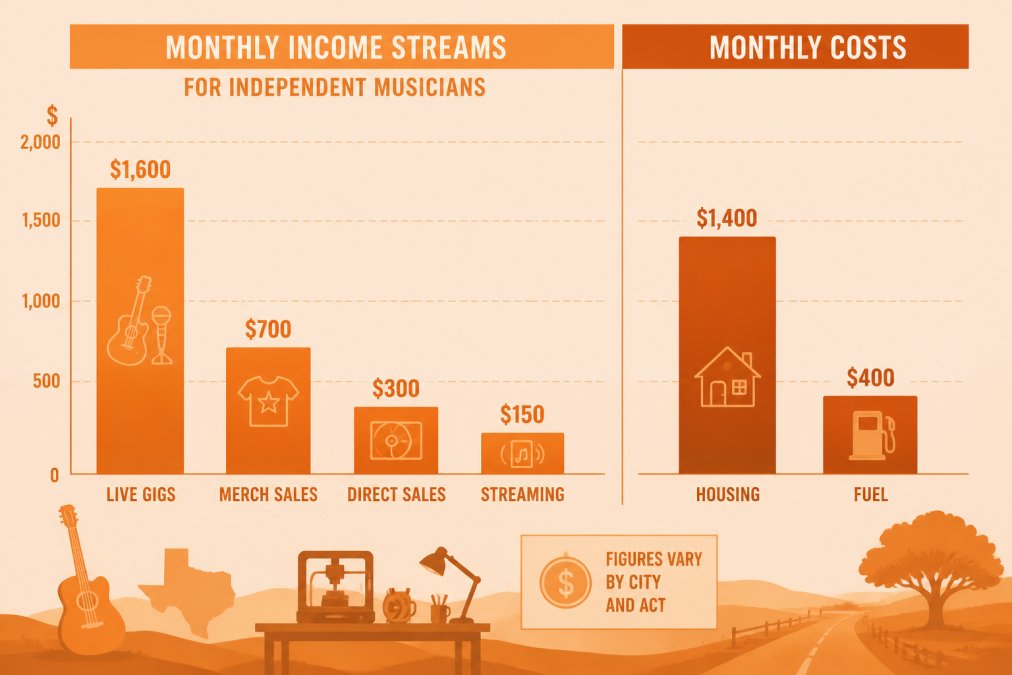
The Five Income Streams, Ranked by Reliability
Independent musicians may consider five streams. They do not behave the same way.
- Live gigs. The most reliable stream for working players, but the least predictable month to month. A venue that books you in March may go quiet in July, and door deals, guarantees, and tip jars all behave differently.
- Merch sales. The highest margin per dollar and the stream most under the artist's control. A shirt or CD sold at the merch table keeps far more money with the artist than the same fan streaming the record for a year.
- Direct music sales. Physical CDs, vinyl, cassettes, and direct downloads.
- Tips. Unpredictable but real, especially at smaller rooms and songwriter nights. Tips reward stage presence and a clear ask more than raw talent.
- Streaming. The lowest per-unit payout of the five. Useful for discovery and for proving an audience exists, not for paying rent.
The Expense Side Nobody Budgets For
An independent musician's budget can include more line items than rent and fuel. Build the full picture:
- Housing. The largest single line, and the one most sensitive to which Central Texas community you live in. A player commuting from a smaller town to metro gigs trades rent for fuel and time.
- Transportation. Fuel, maintenance, and insurance on a vehicle that hauls gear. A van or truck that can carry a full rig costs more to run than a commuter car, and breakdowns are a career problem, not just an inconvenience.
- Gear and consumables. Strings, cables, sticks, reeds, batteries, and the slow replacement cycle on amps and pedals, small individually, significant annually.
- Rehearsal space. Free rooms are scarce. Bands split storage or rehearsal rent, and solo artists often rehearse at home and absorb the noise tradeoff.
- Recording and release costs. Even a modest three-song demo has a cost, whether it is studio time, a producer, mixing, or duplication.
- Platform and distribution fees. Distribution, website hosting, and payment processing all take a cut.
- Health, insurance, and retirement. The line item independent artists most often skip, and the one that makes the difference between a hobby that pays and a career that lasts.
How Many Shows to Break Even
The honest answer is that the number varies too much by act, genre, and venue to quote a single figure. Build your own break-even calculation:
- Add up your true monthly costs across every line above.
- Subtract reliable non-music income, if any.
- Divide the remainder by your average net per show, after fuel, gear wear, and any split with bandmates.
- That number is how many shows per month you need just to break even, before you pay yourself anything.
Quality-of-Life Tradeoffs Beyond the Ledger
The budget is only half the decision. The other half is whether the life around the work is sustainable:
- Transportation and commute time. Living farther out lowers rent but adds hours in the car and raises the cost of every late-night gig.
- Housing stability. Rising rents in growing metros push artists to renegotiate housing every year or two, which disrupts rehearsal schedules and gear storage.
- Rehearsal access. Shared space, noise ordinances, and neighbor tolerance all shape how often a band can actually practice.
- Community. The artists who stay tend to have a peer group they trade bills and referrals with. Isolation is a quiet career killer.
- Work-life balance. A day job that funds the music can also crowd out the evenings and weekends when gigs happen.
Run the budget, then run the life. If both hold up, the scene is worth it for you. If only one does, you have found the real constraint.
A Musician's Path Into the Scene
A practical path looks like this:
- Attend before you ask. Go to the rooms you want to play, on weekdays, and meet the people running them.
- Record something bookable. A clean three-song demo and a short live clip are enough to start.
- Open for someone. Opening slots are the standard entry point and the fastest way to make a name.
- Trade bills with peers. Split nights with artists whose audience overlaps yours.
- Build a local following before chasing regional ones. Venue access follows draw, not the reverse.
How to Support Independent Musicians in Practical Ways
Supporting independent musicians can be concrete: buy the record, buy the shirt, buy the ticket, and tell one other person.
The benefits of supporting independent artists include:
- Buy physical music and merchandise directly at shows
- Pay the cover even when it is a suggested donation
- Share a specific song with a specific reason, not a generic plug
- Follow the artist's actual channels so you see announcements
- Bring one friend to a weeknight show
Why Independent Artist Merchandise Matters More Than a Stream
- Pros: direct revenue, artist control, something physical to keep, and if you want the deeper case, see why buy independent artist music
- Cons: costs more upfront than a subscription you already pay for
How to Buy Music Directly From Independent Artists
Buying music directly from independent artists means going to the source: the artist's own store or the merch table at a show.
If you are new to physical collecting, where to buy physical music covers vinyl, CDs, and cassettes and how to start a collection without overspending. If you want to start with us, you can browse TXMRB country music CDs directly.
Asking whether the music quality holds up against streaming is fair.
Choosing Which Independent Artists to Follow and Support
Before committing, learn what quality to look for in independent artist music.
| What to check | Why it matters | Red flag |
|---|---|---|
| Catalog depth | One single, no follow-up | |
| Live schedule | No dates listed anywhere | |
| Direct sales channel | Streaming only | |
| Communication | Anonymous storefront |
Best for: fans who want a long-term relationship with an artist's work. Skip if: you only want background playlist music and no attachment.
Frequently Asked Questions
Is Central Texas a good place for independent musicians?
It depends on what you want from it. The scene offers no guaranteed income.
How can fans support independent musicians beyond streaming?
Fans can buy physical CDs, downloads, and independent artist merchandise, attend local gigs, and share shows with friends.
How do I discover local independent music in Central Texas?
Check local listings and follow the bands you like directly. Ask at record shops, watch who opens for touring acts, and follow independent artists on social media.
What should a musician consider before joining a local music scene?
Budget first. Weigh expected gig pay and merch sales against housing, fuel, and gear costs. Then assess venue access and competition: how many similar bands already book the rooms you want? Build relationships with bookers and other bands, and treat the scene as a long game.
The Central Texas independent music scene rewards the people who participate in it rather than the ones who wait to be discovered. If you want a place to start, we would point you to the music and handmade goods we build in Liberty Hill: original Texas country records, storytelling, and 3D-printed pieces made by an independent artist who is in this for the long haul. Browse the shop at TXMRB.com and find something that puts you inside the scene instead of watching it.
