

Benefits of Supporting Independent Artists
Table of Contents
- Why Supporting Independent Artists Matters More Than Ever
- Creative Freedom and Artistic Autonomy
- Direct Connection Between Artists and Their Audience
- Financial Control and Fair Compensation for Creators
- Why Buy Handmade Products: Quality, Story, and Craft
- How to Support Independent Musicians Beyond Streaming
- Community Building and Local Economic Impact
- The Environmental Case for Independent Over Mass-Produced
- Frequently Asked Questions
Last Updated: September 14, 2026
Why Supporting Independent Artists Matters More Than Ever
Supporting independent artists means choosing to spend your money directly with the people who make the work, rather than routing it through labels, licensing middlemen, or mass-production factories. That choice keeps creative control and fair pay in the hands of the maker. This guide breaks down the real benefits, from artistic autonomy to local economic impact, and shows what you can actually do.
The case for independent art has never been stronger. As digital distribution has made it easier than ever for unsigned talent to reach an audience directly, more creators are choosing the direct-to-fan route instead of chasing traditional gatekeepers. What most people miss is that this shift isn't just good for artists. It changes what gets made, how it gets made, and who benefits when you spend money on it.
Below, we'll walk through concrete benefits and give you specific, actionable ways to support independent artists beyond a single purchase.
Creative Freedom and Artistic Autonomy
Creative freedom is the single biggest benefit of a thriving independent arts scene, because artists who answer directly to their audience can make the work they actually want to make. No committee, no label executive, no algorithm deciding what's "safe."
That autonomy shows up in the creative process itself. An independent musician can write about hard lessons or second chances without a marketing team asking whether it fits a demographic. A maker can release a weird color combination or a niche product because one customer asked for it. The result is work with artistic integrity, and a niche market that gets served instead of ignored.

Traditional industry structures often filter out anything that doesn't fit a proven formula. When artists bypass those filters, you get creative expression that reflects a real person rather than a focus group.
Direct Connection Between Artists and Their Audience
A direct-to-fan relationship is the difference between knowing an artist's work and actually knowing the artist. Independent creators can talk to you, answer you, and build something with you, without a publicist standing in the middle.
That authentic connection changes how the work lands. When you hear the story behind a song or a handcrafted piece, you're not just consuming a product. You're participating in someone's creative journey. Fans who follow an unsigned musician from an early release often describe a stronger attachment to the work than to anything they've streamed from a major label.
Financial Control and Fair Compensation for Creators
Fair compensation is the practical core of supporting independent artists. When money flows directly from buyer to creator, more of it stays with the person who did the work.
Streaming pays fractions of a cent per play, and those fractions are split across labels, distributors, and platforms before an artist sees anything. A physical release or a handmade product works differently. A CD sold directly to a fan puts a significant portion of the purchase price in the artist's hands, which is why physical media still matters for independent musicians building real revenue streams.
That financial control has a second effect: it funds the next project. Money from one release pays for the next recording, the next batch of materials, or the next round of design work. Patronage in this model isn't charity. It's a direct investment in more art.
Why Buy Handmade Products: Quality, Story, and Craft
Buying handmade products gets you something mass production can't offer: a specific object made by a specific person, with visible craft and a story attached. Quality control happens at the bench, not on an assembly line.

There's a practical side here too. Small-batch makers tend to stand behind their work because their reputation is the business. If something arrives damaged or doesn't fit, you're usually talking to the person who made it, not a call center reading a script. That accountability is hard to replicate at scale.
Where it falls short: handmade goods often cost more than factory alternatives, and availability can be limited since items are made to order. That trade-off is real. You're paying for materials, labor, and the attention to detail that goes into each piece.
| What You Get | Mass-Produced | Independently Made |
|---|---|---|
| Who made it | Often a large factory | Named maker |
| Batch size | Large scale | Small or made to order |
| Design input | Market-driven | Artist's call |
| Problem resolution | Standard customer service | Direct with maker |
| Money flow | Distributed across various entities | Mostly to creator |
How to Support Independent Musicians Beyond Streaming
Supporting independent musicians takes more than adding a song to a playlist. Direct purchases, physical media, and sharing their work all move the needle in ways streaming alone does not.
Here's what actually helps, roughly in order of impact:
- Buy the physical release. A CD or vinyl copy pays far more per unit than any streaming payout.
- Purchase merchandise and handmade goods, which often carry better margins than music alone.
- Share a specific song or product with one person who'd genuinely like it, not a generic repost.
- Attend local shows and buy from the merch table, where artists keep the largest share.
- Join an artist's email list or community so they can reach you without paying a platform for the privilege.
For context on how creator economics have shifted toward direct audience relationships, the Pew Research Center's reporting on the creator economy is a useful starting point.
Community Building and Local Economic Impact
Community building and economic impact are linked more tightly than most people realize. Money spent with independent artists tends to stay closer to home, because independent creators usually spend locally too, on materials, supplies, booth fees, and services from other small businesses in their own area.
Think of it as a loop with several distinct turns. You buy a piece from a local maker. That maker spends the income on materials from a nearby supplier, food from a local shop, or services from another small business. Those businesses then have more reason to stay open, which keeps foot traffic steadier in the surrounding area. It's a small effect per purchase, but it compounds across a whole independent arts scene.
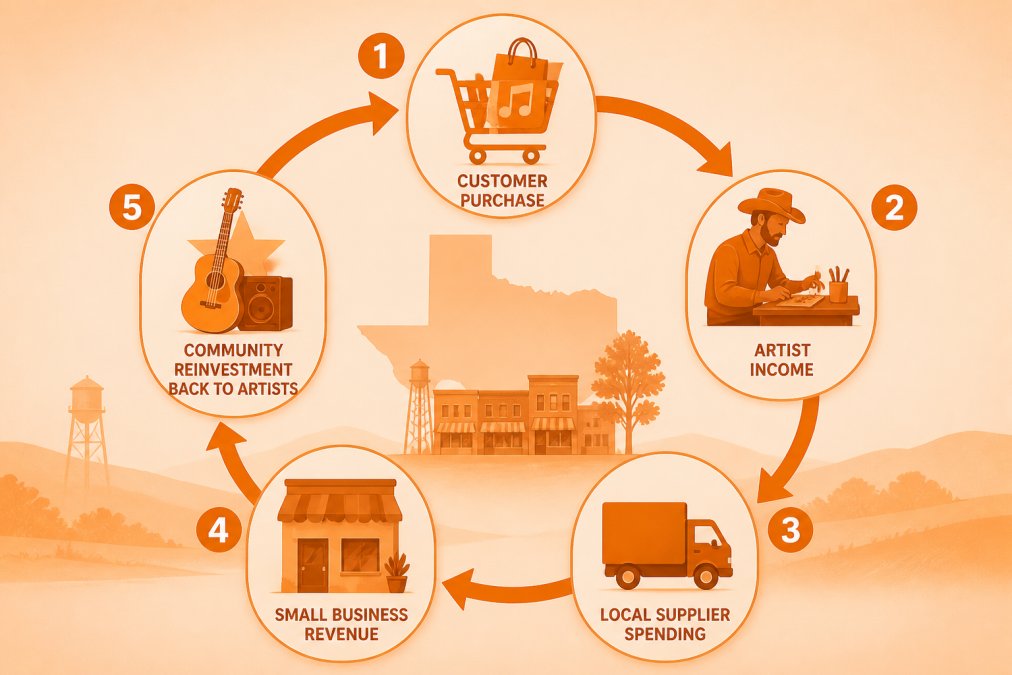
What the loop looks like in practice
The mechanism is easier to see when you break it into steps:
- Direct purchase. You buy a handmade item, a physical album, or a commissioned piece. The full amount goes to the maker instead of being split across a distributor, a platform, and a retailer.
- Local sourcing. The maker buys raw materials, packaging, or components, often from regional suppliers rather than overseas factories.
- Local services. Booth fees at a farmers market, a spot at a craft fair, printing at a local shop, or help from another small business all recirculate the same money.
- Civic spillover. A visible arts scene gives neighbors a reason to gather, which supports the venues, coffee shops, and public spaces that host it.
Why this matters beyond the money
A strong independent arts scene is also a cultural asset. Local shows, markets, and public art give a place its character, and that character is hard to manufacture once it's gone. When you buy from an independent creator, you're not just funding one person's work, you're helping keep the venues, markets, and gathering spaces that make that work possible.
How to support beyond just buying
Most articles stop at 'buy something.' The bigger lever is everything around the purchase. Here are concrete ways to support independent artists that cost little or nothing:
- Share a specific piece, not a generic repost. Send one song, one product link, or one photo to a single person who would genuinely like it. Specific shares convert far better than broad ones.
- Attend in person when you can. Shows, markets, and pop-ups put you in the same room as the maker, and merch tables are where artists often keep the largest share.
- Engage with the work. Leave a review, reply to a post, answer a question in a comment, or send a note about which piece you bought. That feedback loop often shapes the next release or product run.
- Join the artist's email list or community. It lets them reach you without paying a platform for the privilege, and it keeps you in the loop on new work.
- Commission something. A custom piece is one of the highest-impact ways to support a maker, because it funds a project that wouldn't exist otherwise.
- Introduce them to a venue, a market, or another maker. A single introduction can open a door that a hundred likes won't.
This is the 'tangible difference' argument in practice. You can see where your money went, and you can see who it helped. And the cultural value of a strong local arts scene, from shows to markets to public art, tends to follow the money that supports it.
The Environmental Case for Independent Over Mass-Produced
Independent production usually means smaller batches, less overproduction, and shorter supply chains, which reduces waste compared to mass manufacturing. That's the honest version of the environmental argument, without overstating it.
The overproduction problem
Mass-produced goods are made in huge runs based on forecasts. When the forecast is wrong, unsold inventory gets discounted, landfilled, or incinerated. The fashion and consumer-goods industries have built entire business models around predicting demand months in advance, and when those predictions miss, the waste is enormous. Small makers typically produce to order or in limited batches, so there's far less dead stock sitting in a warehouse waiting for a buyer who never comes.
Shorter supply chains, fewer miles
Shipping distances are often shorter when you buy from a maker in your region rather than a factory overseas. A handmade item that travels a few hundred miles has a very different footprint than one that crosses an ocean in a container ship and then moves through a distribution network before reaching you. That's not a perfect comparison, container shipping is efficient per unit, but the last-mile and warehousing layers add up.
Materials and repairability
Many independent makers work in materials they can source in smaller quantities and use efficiently, and they often design for repairability or modularity rather than planned obsolescence. A piece built to be adjusted and rebuilt outlasts one designed to be replaced. That's a durability argument as much as an environmental one: the greenest object is usually the one you don't have to replace.
The honest trade-offs
It's not a perfect comparison. Small-scale production can be less energy-efficient per unit than a large optimized facility, and a single maker working alone may not have access to the same recycling or waste-reduction infrastructure as a factory. The environmental case for independent art isn't that it's automatically greener, it's that the overproduction problem is real, and buying intentionally from independent makers can be a way to reduce your own footprint.
A modern angle: technology and AI
There's a newer layer to this conversation. As AI-generated art and mass-produced digital goods become more common, the environmental and cultural case for human-made work gets stronger, not weaker. AI tools can churn out images, music, and designs at near-zero marginal cost, but they also concentrate value in a handful of platforms and reduce the number of people actually making things. Independent artists who use technology deliberately, for 3D printing, digital distribution, or direct-to-fan tools, can scale their work without giving up the human element that makes it worth owning.
The takeaway is simple: buying from an independent maker is a small, repeatable choice that can help reduce waste, support repairable goods, and keep human creativity in the loop. It won't solve everything, but it's a lever you actually control.
Frequently Asked Questions
What are the primary benefits of supporting independent artists?
The main benefits include helping creators earn fair compensation, preserving artistic freedom, and getting access to unique products you will not find in big-box stores. When you buy from independent artists, your money goes directly to the person who made the work. That direct-to-fan relationship means more creative control for the artist and a more authentic connection for you as a buyer.
How does buying handmade products impact the local economy?
Money spent with local makers tends to stay in the community longer. Independent artists often source materials locally, hire nearby services, and spend their income at other small businesses. This creates a ripple effect that supports jobs and foot traffic in your area. Choosing handmade over mass-produced items keeps more dollars circulating close to home.
Why is direct support more effective for independent creators than streaming?
Streaming pays a fraction of a cent per play, so even thousands of streams may generate very little income for an unsigned musician. Buying a CD, a digital download, or merchandise sends a much larger share directly to the artist. Direct purchases also build a stronger fan base because the artist can thank you personally and keep you updated on new releases.
How can individual consumers help sustain independent creative careers?
Buy directly from artist websites when possible, share their work with friends, and attend local shows or markets. Even small purchases add up. You can also leave reviews, follow artists on social media, and choose handmade gifts over mass-produced ones. These actions provide steady revenue streams and help independent creators keep making new work.