

Why Handmade Fidget Toys Cost More: Real Costs Behind the Price
Table of Contents
- What Actually Drives the Cost of Handmade Fidget Toys
- Small-Batch Production vs Mass-Produced Toys
- The Benefits of High-Quality Fidget Toys for Focus
- How to Choose a Durable Fidget Toy That Lasts
- Maker Economy: What Buying From an Independent Creator Supports
- Do Handmade Fidget Toys Hold Their Value?
- Conclusion
- Frequently Asked Questions
Last Updated: September 21, 2026
What Actually Drives the Cost of Handmade Fidget Toys
Handmade fidget toys cost more because every unit carries real labor, machine time, and material waste that mass production spreads across thousands of identical pieces. A small maker prints one at a time, often made to order, so the price reflects the actual work behind that single object.
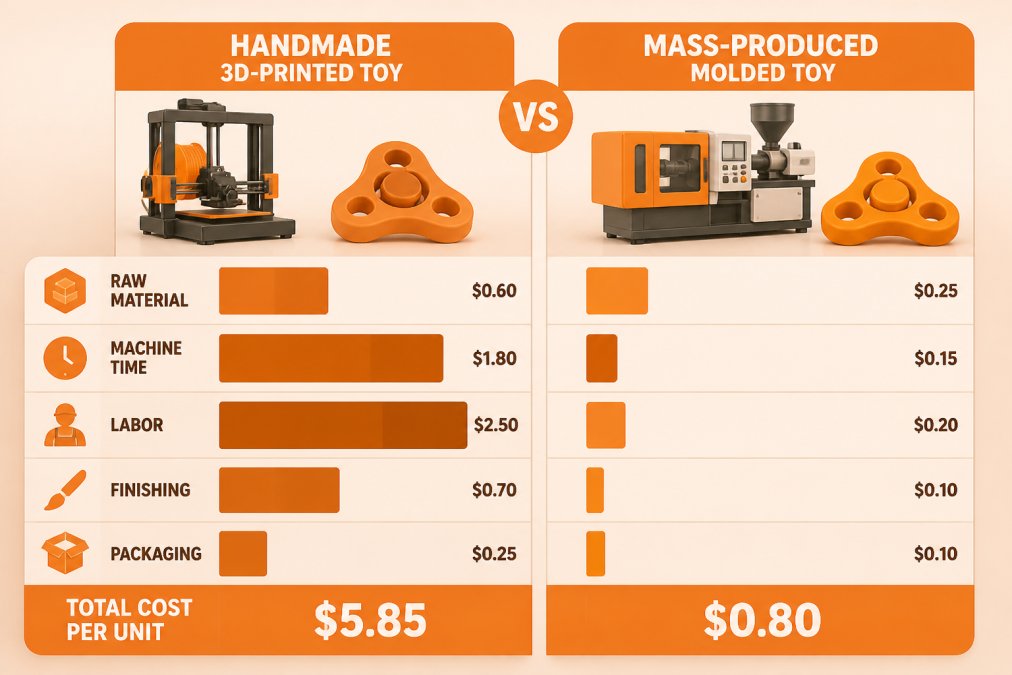
At TXMRB, we build fidgets one at a time in Liberty Hill, Texas. A 3D-printed piece can take hours on the machine, and a failed print means that filament is gone, no scrap credit, no bulk discount.
Raw Material Costs and Where They Go
Material is the smallest line item, which surprises people. PLA filament, the bio-based thermoplastic used in most desktop 3D printing, is genuinely inexpensive per kilogram. So why does a small printed fidget still cost more than a molded one?
Because material cost is not the same as material waste. A mass producer buys resin by the railcar and runs a mold with zero offcuts. A small maker buys filament by the spool and accepts failed prints, discarded supports, and colors that sit until someone orders them.
Then there is finishing: removing supports, sanding edges, checking that joints move freely, and reprinting anything that binds.
Small-Batch Production vs Mass-Produced Toys
Small-batch production means making items in limited runs or one at a time, which keeps quality control tight but eliminates every economy of scale. Mass production drives per-unit cost down with tooling that only pays off at volume.
| Factor | Small-Batch / Handmade | Mass-Produced |
|---|---|---|
| Tooling cost | None (no molds) | High upfront mold cost |
| Per-unit cost | Higher | Lower at volume |
| Design changes | Immediate | Requires retooling |
| Color options | Wide, often made to order | Limited to production runs |
| Quality control | Per-item inspection | Statistical sampling |
| Lead time | Days, made to order | Weeks, batch shipping |
What Injection Molding Does to Price and Quality
Injection molding produces smooth, uniform parts at a fraction of the per-unit cost, but it locks the design in place and removes the small variations that make handmade goods feel individual.
The Benefits of High-Quality Fidget Toys for Focus
High-quality fidget toys support focus because they provide consistent, satisfying tactile feedback that occupies restless hands without demanding attention. A tool that clicks smoothly fades into the background; a cheap one that jams becomes its own distraction.
Why Tactile Feedback Is the Actual Product
When you use a fidget, you are not buying plastic. You are buying a specific feel: the weight in your palm, the resistance at the joint, the sound (or silence) of movement, and the texture under your thumb. That combination is what makes the tool useful rather than annoying.
- Consistent resistance. A printed joint can be tuned so every rotation feels the same. Molded parts depend on tool tolerances, and once the tool is cut, the feel is locked in.
- Weight distribution. The maker controls wall thickness and infill, which changes how the object sits in the hand. A hollow molded shell and a deliberately weighted printed piece feel completely different.
- Sound profile. Some people need a quiet fidget for meetings; others want an audible click. A small maker can offer both from the same design.
- Surface texture. Layer lines, sanded finishes, and material choice all change how the object feels against skin over long sessions.
The Ten-Minute Test
The clearest way to judge a fidget is not the first thirty seconds but what happens after ten minutes. A good one disappears from your awareness: your hands stay busy, your attention stays on the task. A bad one keeps pulling you back because of a wobble, a squeak, a sharp edge, or a joint that catches.
Ergonomics Decide Whether It Gets Used
Ergonomics matter more than most buyers expect. A roller that fits your palm and spins without wobble gets used; one that is too small, too light, or too noisy gets tossed in a drawer. The 'fidget factor' comes down to how the object feels during repeated use, not how it looks in a photo.
How to Choose a Durable Fidget Toy That Lasts
Choose a durable fidget toy by checking three things: material, joint construction, and how it handles repeated stress. PLA is lightweight and strong for everyday handling, but the failure point in most fidgets is the joint, not the material.
- Material listed clearly. If the seller will not say what it is made of, that is a signal.
- Joint design described. Hinges, pins, and snap connections are where wear shows up first.
- No sharp edges or exposed thin walls. Thin printed walls crack under repeated flexing.
- Made to order or small batch. This usually means the maker inspects each piece.
- Replacement or repair path. Ask whether a broken link or joint can be fixed rather than trashed.
- Real photos, not just renders. Layer lines and finish should be visible.
Maker Economy: What Buying From an Independent Creator Supports
The maker economy is the network of independent creators, small studios, and solo operators who design and produce their own goods rather than reselling factory output. Buying from it sends money directly to a person instead of through a chain of distributors and markups.
Do Handmade Fidget Toys Hold Their Value?
Handmade fidget toys hold value better than mass-produced ones when they are scarce, well-made, and tied to a specific maker, but they are not financial investments. Treat them as objects you enjoy owning, not assets you expect to appreciate.
What determines whether a piece holds value:
- Maker reputation. Work from a known creator is easier to resell than anonymous output.
- Condition. Wear and tear on joints and finish is the first thing a buyer checks.
- Original packaging. The dragon egg, for instance, is both display and protective shell, so keeping it matters.
- Production status. A discontinued design is worth more than one still available new.
The Value Argument Almost Nobody Makes: Repairability
Resale price is the wrong frame for most buyers. The stronger case for a handmade fidget is that it can be kept alive instead of thrown away, a long-term value argument disposable plastic toys cannot match.
Maintenance: What Actually Kills a Fidget
The most common failure is not a dramatic break but gradual binding. A quick wipe and a check that nothing is jammed keeps most printed fidgets working for a long time.
A simple maintenance routine:
- Wipe the joints. A dry cloth or a soft brush clears lint before it packs in.
- Check for debris. Sand, crumbs, and hair are the usual culprits behind a sudden catch.
- Test the range of motion. If a joint feels tighter than it used to, clean it before forcing it.
- Store it dry. Moisture and metal pins do not mix well over long periods.
- Keep the packaging. A case or shell protects the finish and the mechanism between uses.
Material Science: Why the Material Choice Matters
Not all filament is the same, and the difference shows up in how a fidget ages. PLA is the most common desktop 3D printing material: rigid, holds fine detail well, and feels solid in the hand, which is why it works for articulated pieces and precision joints. Its trade-off is heat sensitivity, a PLA fidget left on a car dashboard in summer can soften and warp.
The Honest Caveat
Most handmade fidgets are worth roughly what you paid, and that is fine. The value proposition is daily use, not appreciation. If the object does its job for years, can be cleaned and repaired instead of replaced, and was made by someone who stands behind it, it has already returned the money in focus and satisfaction.
Conclusion
The price of a handmade fidget reflects labor, machine time, finishing, and the willingness of one person to build something properly instead of cheaply. That is why the comparison to a mass-produced toy is never quite apples to apples.
Frequently Asked Questions
What materials are used in high-quality handmade fidget toys?
Most handmade fidget toys are built from materials a maker can control at the bench. PLA and other bio-based thermoplastics are common for 3D-printed pieces because they are lightweight and hold detail well. Resin casting and precision machining show up in heavier metal or mixed-material builds. At TXMRB, each fidget is printed in PLA in Liberty Hill, Texas, one at a time, so the material choice is tied directly to how the piece feels in your hand.
Why do small-batch fidget toys last longer than mass-produced versions?
A small-batch maker handles every unit, so flaws get caught before shipping. Production time per piece is longer, and quality control happens at the bench rather than at the end of a conveyor. That means fewer weak joints, cleaner finishing, and moving parts that were tested by hand. Mass-produced toys are built to hit a per-unit cost target.
What is the difference between 3D-printed fidgets and injection-molded toys?
Injection molding needs a steel mold, so the cost only makes sense at high volume, often thousands of units. That pushes makers toward simple shapes and cheap plastic. 3D printing has no mold cost, so a maker can build a complex articulated design, tweak it, and print one at a time. The tradeoff is production time: each piece takes hours of machine time, which is part of why handmade fidget toys cost more.
How does supporting independent creators impact the value of a fidget toy?
When you buy from an independent maker, the money stays with that person instead of spreading across a supply chain of middlemen. You also get a piece that can be customized, replaced, or repaired by the same hands that made it. That connection is part of the value proposition. TXMRB fidgets start at $3, are made to order in Texas, and ship in 2 to 5 business days.