

Why Handmade Items Cost More: Real Costs Explained
Table of Contents
- The Real Costs Behind Every Handmade Item
- How to Price Handmade Items Without Guessing
- Why Small-Batch Production Costs More Per Unit
- Mass-Produced vs Handmade: A Side-by-Side Breakdown
- The Benefits of Supporting Independent Artists
- What Handmade Items Cost at TXMRB
- Conclusion: What You're Actually Paying For
- Frequently Asked Questions
Last Updated: September 20, 2026
The Real Costs Behind Every Handmade Item
When someone asks why handmade items cost more, the honest answer is that a handmade item is a record of hours, not a unit off a line. At TXMRB, every piece starts as a file on a screen, gets printed one at a time in Liberty Hill, Texas, and is finished by hand before it ships.
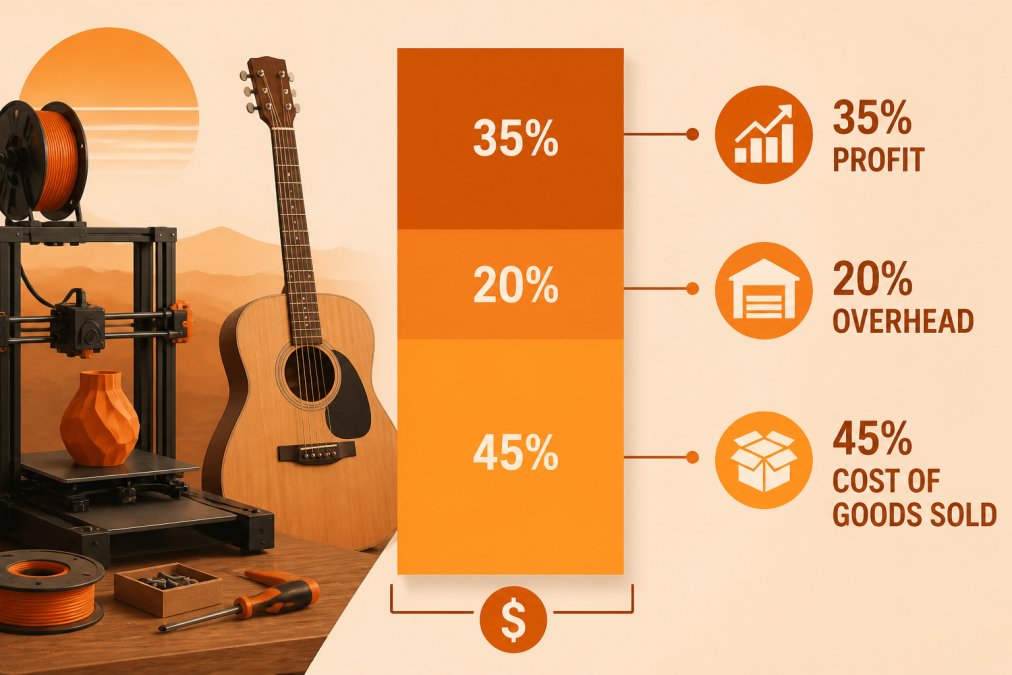
The U.S. Small Business Administration's guide to pricing products and services frames it plainly: price has to cover cost of goods sold, overhead, and a profit margin, or the business does not survive. Handmade sellers feel that math more acutely because their volume is low.
So the price on a handmade item is not a markup on materials. It is materials, plus labor at a fair wage, plus a share of the tools, power, and time that never show up on a receipt.
Labor Is the Biggest Line Item
Labor is where handmade pricing diverges most sharply from mass production. A factory spreads one worker's wage across thousands of units per shift; a small maker spreads theirs across one item at a time.
Consider a simple printed accessory. The design work happens once, but setup, printing, support removal, sanding, assembly, and quality checks happen for every piece, and time is the one input you cannot buy in bulk.
A common mistake is pricing only the visible minutes.
How to Price Handmade Items Without Guessing
Pricing handmade work starts with one formula: cost of goods sold, plus overhead, plus profit margin, equals your retail price.
| Cost Layer | What It Includes | How to Calculate |
|---|---|---|
| Cost of goods sold | Raw materials, direct labor, packaging | Materials + (hours × your hourly wage) |
| Overhead | Power, equipment wear, software, shipping supplies | Monthly overhead ÷ units sold per month |
| Wholesale pricing | Price for shops buying in bulk | Roughly half of retail |
| Retail markup | Your direct-to-customer price | Cost of goods sold × 2 to 3 |
| Profit margin | What funds growth and slow months | Retail price minus all costs |
Materials, Overhead, and the Profit Margin
Raw materials are the easiest cost to see and the easiest to underestimate. Filament, hardware, packaging, and shipping supplies all carry a price, and a failed print or miscut sheet still consumed material.
Why Small-Batch Production Costs More Per Unit
Small-batch production costs more per unit because economies of scale work in reverse when volume is low. Follow one fixed cost through two batch sizes to see it.
Minimum Order Quantities Raise the Material Price
Factories buy raw material by the pallet or truckload and negotiate a per-unit price a small shop cannot touch. A small maker often buys single spools, small boxes, or single sheets, which carries a higher cost per unit.
Waste Hits a Small Shop Harder
Mass production treats defects as a known percentage built into the price across thousands of units. A failed print, miscut sheet, or warped piece in a small shop is absorbed across the handful of units in that batch instead.
Setup and Changeover Time Never Disappear
Whether a maker produces one item or twenty, the machine still needs to be prepared, monitored, and cleaned. Changing colors, swapping materials, or switching designs adds changeover time a factory minimizes by running one product for hours or days.
Quality Control Is Labor, Not Automation
In a small shop, a person inspects each piece rather than a sampling system pulling one item per thousand. That attention to detail is the point of buying handmade, but it is also hands-on time that has to be paid for.
The Upside of Staying Small
There is a real advantage worth naming. Small-batch production allows customization and one-of-a-kind runs mass production cannot touch. A specific color combination or personalized piece is only possible because the batch is small.
Mass-Produced vs Handmade: A Side-by-Side Breakdown
The mass-produced comparison usually comes down to four trade-offs: price, consistency, uniqueness, and where the money goes.
| Factor | Mass-Produced | Handmade |
|---|---|---|
| Unit price | Lower, driven by volume | Higher, driven by labor |
| Consistency | Identical every time | Subtle variation between pieces |
| Design | Built for broad appeal | Unique design, often customizable |
| Production efficiency | Highly optimized | Time-intensive by nature |
| Money flow | Distributes across a supply chain | Supports one maker directly |
| Repair and replacement | Replace the unit | Often repairable or adjustable |
The Benefits of Supporting Independent Artists
The benefits of supporting independent artists extend past the object in the box. When you buy from a small maker, the money behaves differently than it does when you buy from a mass producer.
The Local Multiplier Effect
Economists describe a pattern called the local multiplier effect: money spent with a locally owned business tends to recirculate within the community more than money spent with a large chain or overseas factory. A small maker spends revenue on local suppliers, services, and expenses, and those businesses spend with other local businesses.
A Feedback Loop Mass Production Cannot Offer
There is also a feedback loop mass production cannot replicate. Independent artists hear directly from buyers, and that input shapes what gets made next. A color request, sizing note, or suggestion can turn into a real product change, sometimes within the next batch.
Ethical Manufacturing at Human Scale
Independent work also tends to favor ethical manufacturing at a human scale. A maker setting their own wage and choosing their own materials makes those calls deliberately rather than optimizing for the lowest cost. That does not make every small shop perfect, but the person making the decisions is also the person doing the work.
What 'Handmade' and 'Made in USA' Claims Actually Mean
The Federal Trade Commission's guidance on "Made in USA" claims matters here too, because it sets the standard for how origin and handmade claims can be described. Buyers who care about where something comes from can ask direct questions and get direct answers, and a maker who can describe their process in detail is giving you more than any label will.
How to Tell If a Product Is Genuinely Handmade
- Ask how it is made. A genuine maker can describe the process, the materials, and the equipment without hedging.
- Ask what happens if it breaks. A maker who offers a real answer about repairs or replacements is telling you they stand behind the work.
- Ask about customization. If a maker can adjust a color, size, or detail on request, that flexibility only exists because they are making it themselves.
- Look for variation. Truly handmade pieces often show subtle differences between units. Identical-perfect repetition across every piece is a sign of a factory, not a workbench.
At TXMRB, that conversation is open. Every piece is designed and printed to order, and the person behind the brand is reachable, which is the whole point of buying independent in the first place.
What Handmade Items Cost at TXMRB
TXMRB keeps its prices visible because the math behind them is simple and worth showing. Every item is designed and printed to order in Liberty Hill, Texas, no warehouse of unsold stock, no bulk supplier discount.
Conclusion: What You're Actually Paying For
The price gap between handmade and mass-produced is no mystery once you break it apart. You are paying for the hour, the setup, the quality check, and the fact that the person who made it set their own wage instead of optimizing it away.
Frequently Asked Questions
How much should you charge for handmade items?
Start with your cost of goods sold: raw materials plus your hourly wage for the time spent making the piece. Then add a share of overhead costs, like tools, electricity, and packaging. Multiply that total by two or three to cover wholesale pricing and retail markup if you sell through shops. Most makers land on a price that pays a fair wage, covers materials, and leaves a profit margin that keeps the business sustainable instead of just breaking even.
How do labor costs impact the price of handmade goods?
Labor is usually the largest single factor in why handmade items cost more. A mass-produced product spreads a few seconds of machine time across thousands of units, while a maker spends minutes or hours on each piece. If a craftsperson values their time at a living hourly wage, that time has to appear in the price. Skip it, and the maker is effectively working for free, which is why so many small creative businesses struggle to stay open.
Why are handmade items considered more sustainable than mass-produced alternatives?
Small-batch production usually means less overproduction, less warehouse waste, and materials sourced in smaller quantities from suppliers a maker knows. Many artisans also choose materials they can trace, like PLA, a bio-based thermoplastic made from renewable plant-derived feedstocks, which TXMRB uses for its 3D-printed bracelets and fidgets. Because items are made to order, there's less dead stock heading to a landfill, and repairs or replacements are often possible instead of forcing a full repurchase.
How can I tell if something is genuinely handmade and not drop-shipped?
Look for specifics. A real maker can tell you the materials, the process, and the production time, and often shows work in progress. TXMRB, for example, prints every piece to order in Liberty Hill, Texas and ships in 2-5 business days, with visible layer lines and surface variations that come from 3D printing. Vague listings with stock photos, identical wording across dozens of shops, and shipping windows of several weeks are common signs of a drop-shipped product.