

Why Artisan Goods Cost More: A Fair Breakdown
Table of Contents
- Why Artisan Goods Cost More Than Mass-Produced Alternatives
- How Artisans Price Their Work
- Handmade vs Mass-Produced Products: Where the Differences Show
- Examples of Artisan Goods and What Makes Them Valuable
- Benefits of Buying Handmade Products
- Is the Price Premium Worth It?
- Frequently Asked Questions
Last Updated: October 11, 2026
Why Artisan Goods Cost More Than Mass-Produced Alternatives
When you pick up a handmade item, whether it's a custom 3D-printed accessory, a jar of small-batch honey, or a hand-stitched piece of clothing, the price tag often makes you pause. Why does artisan goods cost more than something you could grab off a shelf at a big-box retailer? The answer isn't about greed or exclusivity. It's about the fundamental differences in how things are made, who makes them, and what goes into each piece.
At TXMRB, we design and craft every product by hand in Liberty Hill, Texas. From our modular snap bracelets to our articulated dragons and fidget toys, we understand firsthand why artisan goods cost more. The difference between a mass-produced item and a handcrafted one comes down to materials, labor, time, and the economics of scale. When you understand these factors, the premium price starts to make sense, and often feels like a bargain.

This guide breaks down exactly where those costs come from and why supporting handmade goods is worth the investment.
How Artisans Price Their Work
Pricing handmade goods isn't arbitrary, but it's also rarely transparent. Most shoppers see a price tag and assume it's inflated. In reality, artisans work backward from their costs and labor to arrive at a number that keeps them sustainable. Understanding this process reveals why the premium exists.
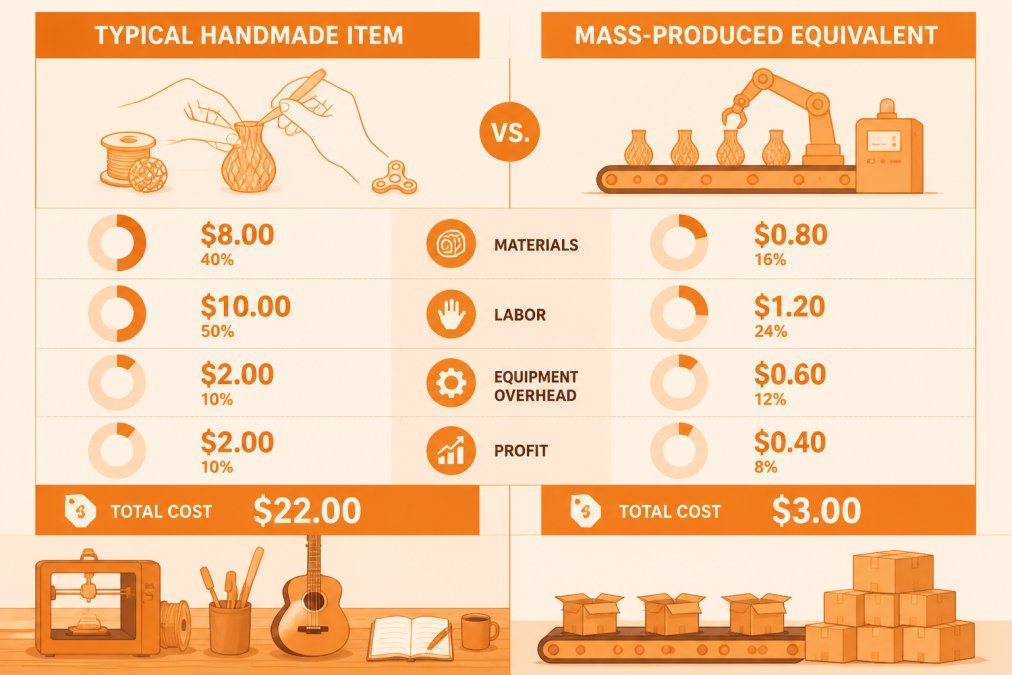
Breaking Down the Real Costs
An artisan's price reflects several distinct layers:
Materials and supplies. A maker buying materials in small quantities pays significantly more per unit than a factory ordering in bulk. If a mass producer sources plastic resin at $0.50 per pound for a 10,000-unit order, an independent maker might pay $2.00 per pound for a 50-unit batch. That difference compounds across every product.
Equipment and tools. Quality 3D printers, woodworking machinery, textile looms, and metalworking equipment represent thousands of dollars in upfront investment.
Labor and time. This is where the largest gap emerges. An artisan might spend 2-4 hours designing, creating, finishing, quality-checking, and packaging a single item. If that maker values their time at $25 per hour (a modest rate for skilled work), that's $50-$100 in labor per piece.
Overhead and workspace. Rent, utilities, insurance, and other fixed costs exist whether a maker produces 10 pieces or 100 pieces that month. A small workshop with $1,500 in monthly overhead producing 100 pieces adds $15 per item. A factory with $50,000 in monthly overhead producing 100,000 pieces adds $0.50 per item.
Packaging, shipping, and fulfillment. Artisans often hand-pack orders and manage shipping individually. A factory uses automated packing lines and negotiates bulk shipping rates. An independent maker might spend $3-$5 per order on packaging materials and $4-$8 on shipping a single item.
Platform and payment fees. If an artisan sells through an online marketplace, they typically pay 3-6% in transaction fees plus payment processing costs. A factory selling direct to retailers or in bulk avoids these fees entirely.
The Math Behind the Price
The difference isn't greed. It's the fundamental economics of small-batch versus mass production. The handmade version includes actual skilled labor, smaller material purchases, and the fixed costs of running an independent operation. The mass-produced version achieves its low price through volume, automation, and accepting lower profit margins per unit in exchange for selling thousands or millions.
Why Artisans Don't Lower Prices
Some makers are tempted to undercut their costs to compete. This leads to burnout, unsustainable business practices, and eventually closure. A sustainable artisan business prices to cover real costs plus a reasonable profit. Anything less is subsidizing the customer's purchase with the maker's unpaid time and financial loss.
When you see a handmade item priced significantly higher than a mass-produced alternative, the premium reflects the real cost of making something by hand, in small batches, with attention to quality. It's not a markup on top of a cheap base cost, it's the actual cost of the work.
Handmade vs Mass-Produced Products: Where the Differences Show
The gap between artisan goods and mass-produced alternatives shows up in measurable ways, but not all handmade items are created equal, and not all premiums are justified. Learning to evaluate quality and authenticity helps you determine whether you're paying for genuine craftsmanship or simply a higher price tag.
Visible and Tangible Differences
Consistency versus character. Mass production prioritizes identical units made to the same specifications. Every item looks and feels the same. Handmade goods carry the maker's touch, small variations in color, texture, or finish that reflect the human hand. This isn't a flaw; it's evidence of individual creation. If you're buying a handmade ceramic mug, slight glaze variations are normal. If every mug is identical, it was likely mass-produced despite claims otherwise.
Durability and longevity. Mass-produced items are often engineered for cost-effectiveness, which sometimes means they're designed to last a set lifespan before replacement. Handcrafted items are frequently built to last indefinitely. An artisan making something by hand has pride in their work and builds for durability. However, durability depends on materials and design, not just handmade status. A handmade item made from cheap materials won't outlast a well-engineered mass-produced alternative.
Quality control and inspection. A factory might inspect a statistical sample of items. An artisan typically inspects every single piece. This human attention catches issues that automated systems might miss. However, small-batch production doesn't guarantee quality. A maker rushing through pieces won't catch flaws. Genuine artisans take time per piece and stand behind their work.
How to Evaluate Whether a Handmade Premium Is Justified
1. Examine materials. Ask what materials are used and why. A maker who can explain their material choices, why they selected a specific wood, resin, fabric, or metal, demonstrates intentionality.
2. Understand the construction method. How is the item made? Is it hand-assembled, hand-finished, or hand-designed but machine-produced? There's a difference.
3. Check for provenance and transparency. Where is the item made? By whom? Can the maker tell you their story?
4. Assess repairability. Can the item be repaired if it breaks? Handmade goods often have an advantage here, a maker can often fix or replace a broken piece.
5. Look at finishing details. Rough edges, uneven seams, or sloppy assembly suggest either a maker who doesn't care or one who is rushing. Quality handmade items show attention to detail in finishing.
6. Compare to similar items. Research other handmade versions of the same product. If one maker's fidget toy costs $40 and another's costs $120, understand why. Is it material quality? Design complexity?
7. Consider the maker's experience. How long has the maker been producing this item?
Red Flags for Inflated Pricing
- A maker can't explain why their item costs more than similar alternatives
- Materials are cheap but the price is high
- The item shows signs of rushed or careless work
- The maker has no background or story to share
- There's no way to contact the maker or ask questions
- The item is marketed as "artisan" or "handmade" but shows no evidence of individual craftsmanship
When Handmade Justifies the Premium
A handmade item deserves its premium when:
- Materials are high-quality and chosen deliberately
- The maker demonstrates expertise and experience.
- The design reflects real user feedback or personal use.
- Construction shows attention to detail and care.
- The maker is transparent about their process and location.
- The item is built to last and can be repaired.
- You can identify concrete reasons the price is higher than mass-produced alternatives.
When all these factors align, you're not overpaying, you're investing in quality, supporting a real person, and getting something designed with genuine care.
Examples of Artisan Goods and What Makes Them Valuable
Artisan goods span every category imaginable. Handmade jewelry, small-batch foods, custom apparel, and 3D-printed accessories all share common traits: they're made with intention, in small quantities, by people who care about the result.
Consider cheese. A small-batch cheesemaker ages their product for months, tending to it carefully. A mass-produced cheese gets made in days with additives and preservatives for shelf stability. The small-batch version costs more because of the time, the skill, and the care involved.
Or take fidget toys. A 3D-printed fidget blade from an independent maker is designed, tested, and printed by someone who uses the product themselves. They iterate based on real feedback. A mass-produced fidget toy might be designed by committee and manufactured in bulk with minimal quality variation consideration. The artisan version reflects actual user experience; the mass-produced version reflects cost optimization.

At TXMRB, our handmade products, from the modular snap bracelet that lets you customize your style to the articulated dragon that sits on your desk, are designed and printed here in Texas. Each piece carries the intention of someone who believes in what they're making.
Benefits of Buying Handmade Products
When you choose artisan goods, you're not just buying a product. You're supporting a person, a small business, and a way of making things that values quality over volume.
Buying handmade means your money goes directly to the creator. There's no massive supply chain, no corporate markup, no middlemen. When you support independent makers, you're funding their ability to keep making. You're enabling someone to do work they believe in.
Handmade goods also tend to be more sustainable. Small-batch production generates less waste. Artisans often source materials thoughtfully because they're paying for them directly. There's no incentive to overproduce. A maker produces what they can sell, nothing more.
There's also the story. Every handmade item has one. It was made by a specific person in a specific place with specific choices about materials and methods. That narrative adds value that mass production can't replicate.
Is the Price Premium Worth It?
Whether the premium price is worth it depends on what you value. If you want the cheapest option, mass-produced goods win. But if you value durability, uniqueness, supporting independent makers, and owning something made with care, artisan goods deliver returns that justify the cost.
A mass-produced fidget toy might break in a month. An artisan fidget blade costs more but lasts years and actually feels good in your hand because someone designed it for real use. When you calculate cost-per-use, the handmade option often comes out ahead.
The same logic applies across categories. A handmade leather wallet costs more upfront but develops character with age and lasts a decade. A mass-produced wallet costs less but wears out in a year or two. The artisan version is cheaper over time.
For gifts and items that matter to you personally, handmade goods carry emotional weight. You're giving something made by a real person, not something stamped out by a machine. That distinction means something.
The next time you encounter a price difference between handmade and mass-produced, take a moment to understand what's actually behind that number. You're not paying extra for a brand or for pretension.
Frequently Asked Questions
Why do handmade products cost more than mass-produced products?
Handmade artisan goods cost more because they require skilled labor, higher-quality materials, and smaller production runs. Artisans invest time perfecting their craft, often using premium raw ingredients or materials. Mass production spreads costs across thousands of units, while small-batch production concentrates those costs on fewer items. Additionally, artisans typically pay themselves fairly for their expertise rather than relying on automation and factory labor.
What factors affect the price of artisan goods?
Key pricing factors include material costs (sourcing quality ingredients or materials), labor time (how many hours of skilled work each piece requires), equipment and overhead (tools, workspace, utilities), production scale (fewer units mean higher per-item costs), and profit margin (what the maker needs to sustain their business). For items like 3D-printed accessories, the design complexity and material type also influence price. Customization and made-to-order production typically cost more than standard designs.
Are artisan goods worth the higher price?
Artisan goods often deliver better durability, unique design, and quality that justify higher prices for buyers who value craftsmanship. You're also supporting skilled makers and small businesses directly. However, the answer depends on your priorities. If you need basic functionality at the lowest cost, mass-produced may suit you. If you value longevity, individuality, and supporting independent creators, handmade products offer real value that extends beyond the price tag.
How can you tell if an artisan product is well made?
Look for consistent quality in materials and finish, attention to detail in construction, and transparency from the maker about their process and materials. Well-made artisan goods should feel substantial in hand, show no obvious flaws or weak joints, and come with clear information about what you're purchasing. Ask the maker questions about their materials, production methods, and any guarantees. Handmade items often carry subtle variations that show individual craftsmanship rather than factory uniformity, this is a sign of authenticity, not poor quality.