

Quality of Independent Artist Music: What Buyers Should Know
Table of Contents
- What Sets Independent Artist Music Apart
- How Technology Raised the Bar for Independent Artist Production Standards
- The Benefits of Physical Music Media for Listeners and Artists
- Objective Benchmarks: How to Judge Sound Quality Without a Studio
- The Quality vs. Virality Paradox in Independent Music
- Budget-Friendly Quality Scaling: Doing More With Less
- Where to Buy Physical Music That Meets Your Standards
- Why Curation Matters in the Independent Sector
- Frequently Asked Questions
Last Updated: September 28, 2026
What Sets Independent Artist Music Apart
Independent artist music is created, owned, and released by the artist without a major label controlling the process. That single fact shapes everything about how it sounds, how it reaches listeners, and why it often carries more personality than a label-polished release.
I'm Michael, the artist behind TXMRB, and I've released country music on my own terms. The difference shows up in the details: the songs you write when no one is asking you to sound like someone else, the arrangements you keep because they feel right, and the stories you tell because they're actually yours.
The independent sector has grown because the tools caught up with the ambition. A songwriter with a laptop, a decent interface, and a clear vision can now release work that holds its own against studio-backed records. What separates the best independent releases from the rest isn't budget. It's intention.
How Technology Raised the Bar for Independent Artist Production Standards
Home recording technology has closed much of the gap between a bedroom setup and a commercial studio. Affordable interfaces, quality condenser microphones, and access to professional-grade software mean independent artist production standards are higher than they've ever been. The bottleneck is no longer equipment. It's knowledge.
A common mistake is assuming gear solves the problem. It doesn't. A $2,000 microphone in an untreated room still captures a bad room. The artists who get the most from modest setups focus on three things first:
- Tracking cleanly, with proper gain staging and no clipping
- Recording in the quietest, most controlled space available
- Getting the performance right rather than fixing it later
Mixing and mastering still matter, and many independent musicians hire out for those steps. That split, tracking at home and finishing with an experienced audio engineer, is one of the most practical ways to raise production value without a label's financial backing.
The Benefits of Physical Music Media for Listeners and Artists
Physical music media gives listeners something streaming can't: a tangible artifact and a reason to sit with an album from start to finish. For artists, it creates a direct transaction that streaming royalties rarely match, plus a format that carries artwork, liner notes, and sequencing intent.
The benefits of physical music media run deeper than nostalgia. A CD demands attention in a way a playlist doesn't. You put it in, you listen to the order the artist chose, and you hold the packaging while you do it. That's curation built into the format.
For independent musicians, physical releases also solve a business problem. They're a product, not just a stream. Something a fan can buy at a show, gift to someone, or collect alongside other records they love.
Objective Benchmarks: How to Judge Sound Quality Without a Studio
Most conversations about independent music quality stay subjective: "it sounds professional," "it sounds homemade." That vagueness is why so many independent artists can't tell whether their release is actually competitive. There are measurable traits you can listen for, and loose target ranges you can aim at, without ever setting foot in a commercial studio.
Here are the four benchmarks that matter most, what they actually mean, and how to check them at home.
- Dynamic range is the distance between the quietest and loudest moments in a track. Modern streaming platforms normalize loudness, so a hyper-compressed master no longer wins a volume war. It just sounds flat and fatiguing. A useful check: import your mix and a reference track you admire into the same session, match their perceived loudness by ear, then toggle between them. If your track feels smaller or more tiring at the same volume, it's over-compressed.
- Frequency balance is how energy is distributed across the spectrum. Two common failure modes: a buildup in the low-mids (roughly the range where guitars, vocals, and kick drum overlap) that makes everything sound muddy, and an aggressive boost in the high-mids that makes vocals sound harsh on earbuds. A spectrum analyzer plugin is free or cheap and shows you exactly where your energy sits versus a reference.
- Noise floor is the level of hiss, hum, or room tone underneath the silence. A clean recording is essentially silent when nothing is playing. If you can hear air conditioning, computer fans, or electrical hum between phrases, that noise gets amplified by compression and mastering later. Fix it at the source: turn off the HVAC, move the mic away from the computer, and use a gate only as a last resort.
- Stereo width is how elements are placed across the left-right field. A mix where everything sits dead center sounds like a demo. A mix where the vocal, bass, and kick are centered and the guitars, keys, and backing vocals are spread wide sounds intentional. Check your mix in mono: if elements disappear or the balance collapses, your stereo image is doing work the arrangement should be doing.
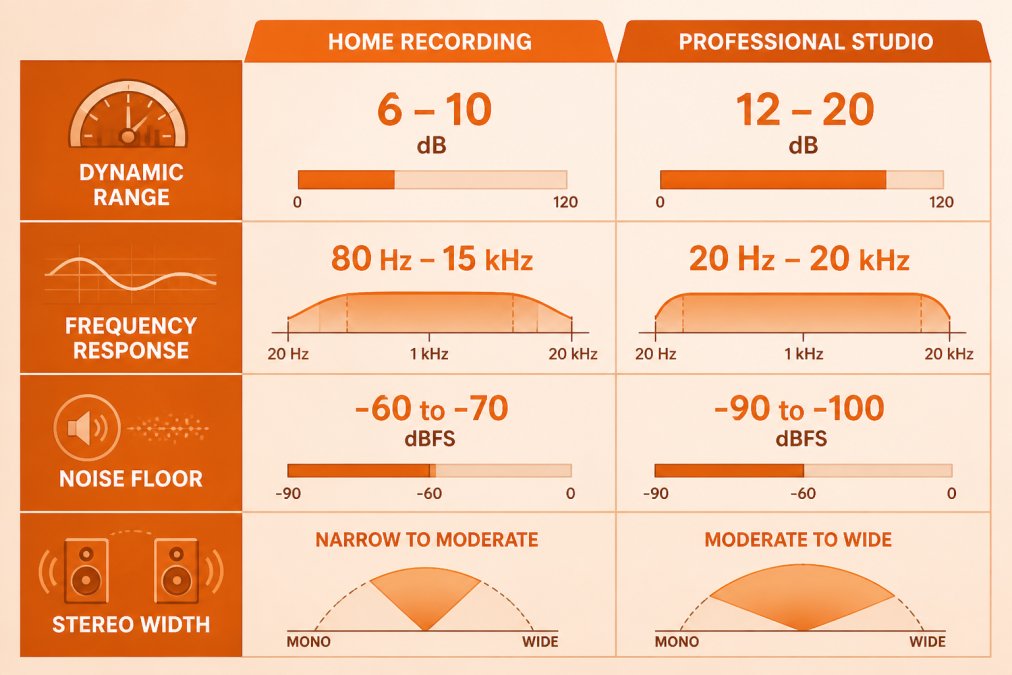
A few practical reference points help. Streaming services normalize playback to a consistent loudness target, so mastering to a moderate integrated loudness rather than the loudest possible level is the modern standard. Most mastering engineers aim for a master that translates on phone speakers, car systems, and earbuds, not just studio monitors. And a well-made track should sound recognizably the same across all three.
The single most useful test costs nothing: listen to a reference track you know intimately, then immediately play yours.
The Quality vs. Virality Paradox in Independent Music
The quality versus virality paradox is simple: the traits that make a song spread fast are often the opposite of the traits that make it last. Short hooks, trend-chasing sounds, and algorithm-friendly formats travel quickly. Deep songwriting, dynamic arrangements, and patient storytelling build a fan base that stays.
Budget-Friendly Quality Scaling: Doing More With Less
A useful way to think about the whole process: every release should sound better than the last one, and the improvement should come from a specific decision you can name. "I treated the room this time." "I hired a mastering engineer." "I recorded the vocal in a quieter space." If you can't name what changed, you probably spent money without moving the needle.
Where to Buy Physical Music That Meets Your Standards
The best place to buy physical music from independent artists is directly from the artist. Buying direct means the money reaches the person who made the record, and you often get signed or limited editions you won't find in a big-box store.
- Is the artist selling it themselves? Direct sales support the maker.
- Is the packaging described clearly? You should know what you're getting.
- Are the tracks the final masters? A serious release states this.
Why Curation Matters in the Independent Sector
Curation is the filter that separates a release worth your time from the flood of new music uploaded every day. With so much music available, the independent sector depends on trusted voices, playlists, and artists who stand behind their own catalog.
Frequently Asked Questions
What defines high-quality music in the independent sector?
High-quality independent artist music comes down to three things: a clean, balanced mix that translates across speakers and headphones, a master with healthy dynamic range rather than crushed loudness, and performances that feel intentional. Production value is not about the size of the studio. It is about whether the low end is controlled, vocals sit clearly in the mix, and the song holds up on repeat listens. A CD from an independent artist can meet those standards just as well as a major label release when the mixing and mastering are done with care.
What are the benefits of buying physical music from independent creators?
Physical music media gives you a permanent copy you own outright, full-resolution audio instead of a compressed stream, and liner notes or artwork that streaming cannot replicate. Buying a CD directly from an independent artist also puts more money in that artist's hands, which funds the next recording. For collectors, physical releases hold value and tell a story. For artists, physical sales offer a stable income stream that does not depend on playlist algorithms or streaming payout rates.
How does independent music differ from major label releases in terms of creative control?
The biggest difference is creative autonomy. Independent musicians decide their own sound, release schedule, cover art, and collaborators without a label approving each choice. Major label deals bring financial backing and industry infrastructure, but they often come with pressure to fit trends or hand over master rights. Staying independent means slower growth for many artists, but it also means the music you hear is the music the artist actually wanted to make, start to finish.
What should listeners look for when evaluating the quality of independent music?
Start with how the track sounds on different systems. A well-produced song holds together on phone speakers, car stereos, and headphones without harshness or mud. Listen for clear separation between instruments, vocals that sit above the mix, and a consistent volume level across tracks on the same album. Check whether the release was professionally mixed and mastered, and read the credits. Artists who invest in audio engineering and take time with sound design usually show it in the final product.