

Benefits of Owning Physical Music Media: 2026 Guide
Table of Contents
- Why Physical Music Media Still Matters in 2026
- Sound Quality and the Listening Experience
- Ownership vs. Licensing: What You Actually Get
- Nostalgia, Tactile Experience, and the Ritual of Listening
- Where to Buy Physical Music in 2026
- Supporting Independent Musicians Through Physical Media
- Preservation, Maintenance, and Long-Term Value
- Conclusion
- Frequently Asked Questions
Last Updated: September 18, 2026
Why Physical Music Media Still Matters in 2026
Streaming gives you everything and keeps nothing. That tension sits at the center of the benefits of owning physical music media, and it explains why collectors keep returning to shelves, crates, and jewel cases. This guide from TXMRB walks through what a physical copy actually gives you that a subscription cannot: a file you control, artwork you can hold, and a direct line to the artist who made it.
The Resurgence of CDs and Vinyl
CDs and vinyl have moved from nostalgia act to active collecting category. Record stores that survived the download era now stock new pressings alongside used bins, and artists increasingly treat a physical release as the primary artifact rather than an afterthought. A CD is inexpensive to press, durable, and easy to ship, which makes it a practical format for independent musicians who want something tangible to sell at shows and online. Vinyl carries more ritual and weight, but it demands more space, more care, and more money. Both formats share one advantage: they exist independently of any platform's licensing decisions.
Sound Quality and the Listening Experience
A physical disc plays the same audio every time you load it, at full resolution, with no buffering and no adaptive downgrade. Streaming services compress audio to save bandwidth, and the bitrate you receive depends on your connection, your device, and your plan tier. On a good system the difference is audible; on earbuds in a noisy room it may not be.
Lossless Audio and Bitrate Explained
Bitrate is the amount of data used per second of audio, measured in kilobits per second. Lossless audio preserves the full recording without discarding data during compression. A standard CD holds uncompressed 16-bit/44.1kHz audio, which is lossless by definition. Many streaming tiers deliver lossy files at lower bitrates, which is why a disc can outperform a stream even when both come from the same master. If you care about fidelity, the format on your shelf is the reference copy.
Ownership vs. Licensing: What You Actually Get
Buying a download or a subscription buys you a license, not a file. That license can be revoked, the catalog can be pulled, and the platform can change its terms. A CD or record is yours outright. You can rip it, lend it, resell it, or play it in twenty years on hardware that does not require an internet connection. Digital rights management exists to restrict exactly those freedoms, and physical media sidesteps it entirely.
Nostalgia, Tactile Experience, and the Ritual of Listening
There is a reason people describe putting on a record as a ritual rather than a task. You choose the disc, handle it, place it, and commit to the side. That friction is the point. A physical copy turns listening into an event instead of background noise, and the liner notes, artwork, and packaging give your hands and eyes something the screen never provides.
Where to Buy Physical Music in 2026
You have three practical paths, and each one trades convenience against connection. Buying direct from an artist's own store puts the most money in the artist's pocket and often gets you signed or limited editions. Local record stores let you browse used stock and talk to someone who knows the catalog. Large online retailers offer the widest selection and fastest shipping but the thinnest margin for the artist.
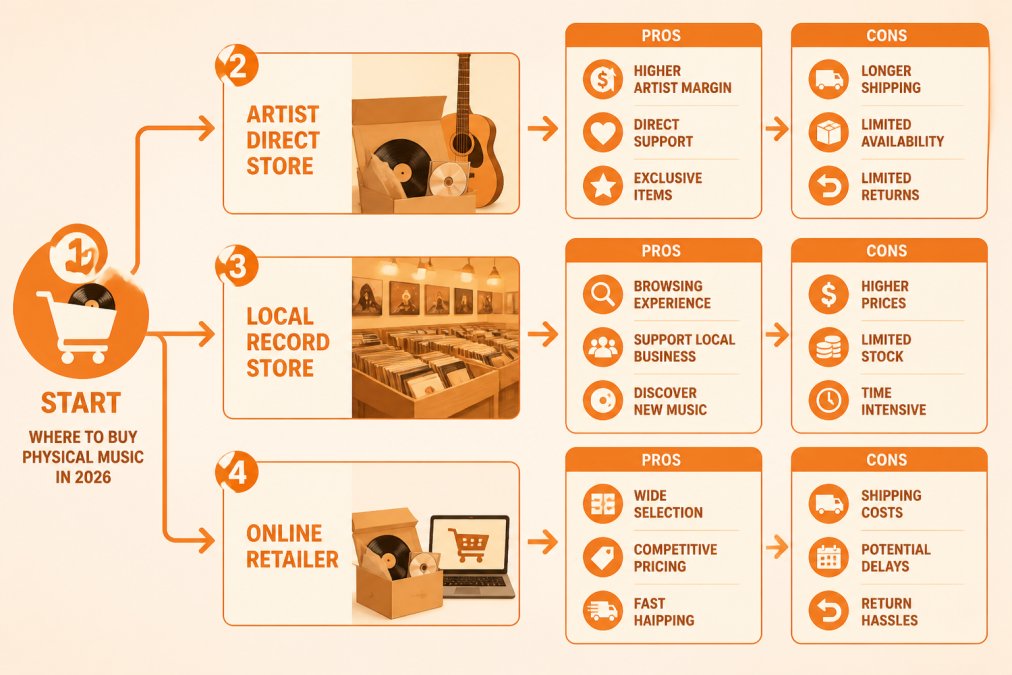
What separates a good purchase from a regret is knowing how each channel handles condition, returns, and provenance.
Buying Direct from Artists
Artist-direct purchases are the highest-impact way to buy. When you order a CD straight from a musician's site, the artist keeps a far larger share than through a distributor or streaming payout. You also get access to signed copies, limited runs, and bundles that never reach retail. [TXMRB's own Wide Open album is a direct example](/products/wide-open-album): a story-driven country record about chasing dreams, second chances, and finding freedom, sold as a physical CD straight from the artist who wrote it.

Buying from Local Record Stores
A good record store is the only channel where you can inspect before you buy. You can check a used CD for deep scratches, hold an LP up to the light for warping, and read the sleeve for water damage. Staff who know the catalog can tell you whether a pressing is an original, a reissue, or a bootleg, and they often set aside interesting trade-ins for regulars.
Buying from Large Online Retailers
Online retailers win on selection and speed. Nearly any in-print title is a search away, and shipping is usually fast. The trade-off is that you buy sight unseen, condition descriptions vary, and a marketplace seller may be flipping a copy they never opened. Read the condition notes, check the return window, and prefer listings that show the actual item rather than a stock photo.
How to Judge a Used Copy Before You Pay
A few habits separate a smart used purchase from a gamble:
- Check the disc, not the case. A cracked jewel case is cheap to replace; deep scratches on the play side are not.
- Look at the deadwax. The run-out groove area on an LP often carries a matrix number and mastering initials that identify the pressing.
- Feel for warping. Lay an LP flat on the counter and sight along the edge. A visible wave will skip.
- Ask about the source. A store that knows its stock can tell you whether a copy came from a personal collection or a bulk buy.
Supporting Independent Musicians Through Physical Media
Every physical sale is a vote for the artist's next project. Streaming pays fractions of a cent per play, so a listener who streams an album hundreds of times may contribute less than a single CD purchase. When you buy physical music media from an independent artist, you fund recording costs, pressing runs, and the time it takes to write the next record.
Preservation, Maintenance, and Long-Term Value
Physical media lasts if you treat it well, and the difference between a disc that plays in thirty years and one that skips next month usually comes down to storage and handling, not luck. Store CDs vertically in a cool, dry place away from direct sun, handle them by the edges, and keep them in their cases.
| Format | Typical Care | Storage Need | Long-Term Outlook |
|---|---|---|---|
| CD | Wipe with soft cloth, handle by edges | Vertical, cool and dry | Decades with careful handling |
| Vinyl | Brush before play, replace inner sleeves | Upright, away from heat | Decades; sensitive to warping |
| Cassette | Clean heads, avoid magnets | Closed case, moderate temperature | Shorter lifespan; tape degrades |
Cleaning and Handling Without Damaging the Disc
Most damage happens during cleaning, not during play. For CDs, wipe in a straight line from the center hole outward, never in a circle, because circular scratches cross the data tracks and cause skips. A soft microfiber cloth and a little distilled water handle fingerprints; harsh solvents can cloud the polycarbonate surface.
Storage Conditions That Actually Matter
Heat and moisture are the two biggest threats. Vinyl warps in a hot car or an attic that bakes in summer; CDs delaminate when humidity swings. A stable indoor room with moderate temperature and low humidity is ideal. Keep shelves off exterior walls and away from radiators, and avoid stacking records flat, which puts pressure on the bottom copies.
The Environmental Trade-Off Nobody Mentions
Most articles skip this, and it deserves a straight answer. Physical media uses plastic, paper, and energy to manufacture and ship. Streaming uses data centers, networks, and devices that run around the clock. Neither is free of impact, and the honest comparison depends on how many times you play a copy.
Resale Value and What Actually Holds It
Maintenance also protects resale value. Limited pressings and out-of-print titles hold or gain value over time, which is something no streaming playlist can offer. A collection is both a listening library and an asset you can pass on.
Conclusion
The case for physical music comes down to control, connection, and care. You own the file, you hold the artwork, and you pay the artist directly instead of renting access from a platform. At TXMRB, every CD and handmade piece is designed and crafted in Liberty Hill, Texas by an independent artist and small-business owner, with fast, secure shipping in 3-5 business days.
Frequently Asked Questions
Why is it important to own physical media instead of just streaming?
Owning physical music media gives you permanent access that streaming cannot guarantee. Streaming services license music, which means tracks can disappear when contracts expire. A CD or vinyl record is yours to keep, play offline, and pass on. Physical formats also often include liner notes, artwork, and higher audio fidelity than compressed streams, making the listening experience more complete and personal.
How does buying physical music directly support independent artists?
When you buy physical music directly from an artist, a much larger share of the sale goes to them compared to streaming payouts. Supporting independent musicians this way funds future recordings, touring, and creative projects. Artists like Michael at TXMRB use direct sales to keep making music without relying on label advances or algorithmic playlists. Every CD purchased is a direct investment in an artist's career.
Is physical music media making a comeback in 2026?
Yes, physical music media has seen a steady resurgence, particularly among younger listeners discovering vinyl and CDs. This comeback is driven by a desire for ownership, nostalgia, and a deeper connection to music that streaming alone cannot provide.
What are the long-term benefits of building a physical music library?
A physical music library offers lasting value: your collection cannot be removed by a streaming service, it often appreciates for rare pressings, and it becomes a personal archive of your taste. Physical copies also include artwork and liner notes that deepen your connection to the music. For collectors, a well-maintained library is both a cultural artifact and a source of daily enjoyment, playable without internet or data caps.