

How to Choose Durable Fidget Toys That Actually Last
Table of Contents
- Why Durable Fidget Toys Are Worth the Search
- Start With a Quick Durability Checklist
- Fidget Toy Materials: What Holds Up Over Time
- Match Construction to How Hard You Fidget
- Best Fidget Toys for Focus: What to Look For
- Are 3D-Printed Fidget Toys Durable Enough?
- Fidget Toy Care and Cleaning That Extends Lifespan
- Repairability, Replacement Parts, and Total Cost Over Time
- Frequently Asked Questions
Last Updated: October 9, 2026
Why Durable Fidget Toys Are Worth the Search
A fidget toy that falls apart in a week costs you more than money. It costs you the calm, focus, or quiet outlet you were counting on. That is why learning how to choose durable fidget toys matters more than chasing the cheapest option.
At TXMRB, we 3D print fidgets by hand in Liberty Hill, Texas, so we think about wear and tear constantly. A fidget gets squeezed, dropped, spun, and pocketed all day. Flimsy ones crack at the seams. Good ones keep the same feel for months.
Below, we break down materials, construction, and care so you can pick a fidget that survives real use.
Start With a Quick Durability Checklist
Run any fidget through five quick questions before you buy. This takes two minutes and saves you from repeat purchases.
The Five Questions to Ask Before You Buy
- What is it made of? Metal, dense plastic, and quality silicone outlast thin, hollow shells.
- How does it feel in your hand? A solid weight usually signals better build quality.
- Are the moving parts tight? Loose bearings and wobbly joints fail first.
- Can it be cleaned? Smooth, non-porous surfaces wipe down easily.
- Can it be repaired? Replaceable parts beat a disposable design.
If a fidget fails two or more of these, keep looking.
Fidget Toy Materials: What Holds Up Over Time
Material decides most of a fidget's lifespan. Each option trades durability against weight, texture, noise, and safety. The table below goes past vague labels and names the actual failure mode you should expect from each material.
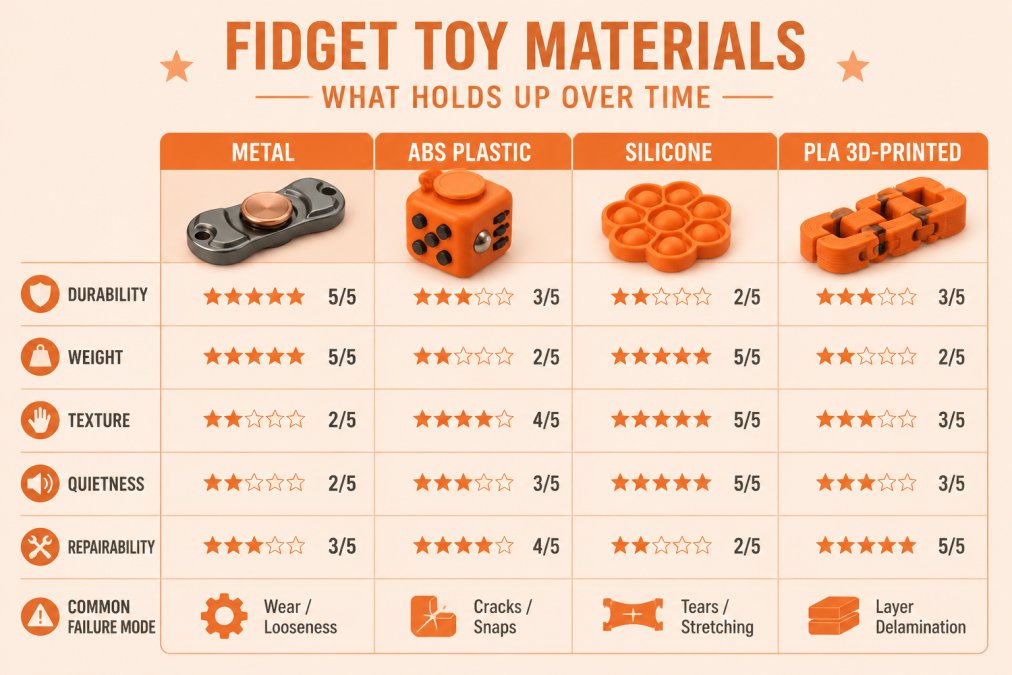
Metal, Plastic, Silicone, and 3D-Printed Options
| Material | Durability | Weight | Common Failure Mode | Best For |
|---|---|---|---|---|
| Metal (stainless, aluminum, brass) | Very high | Heavy | Dents or bends under hard drops; bearings wear out first | Long-term daily use, forceful fidgeting |
| ABS plastic | Medium | Light | Snaps at thin arms and pivot points | Budget spinners, light use |
| Silicone | High | Light | Tears at seams or stretches out of shape over time | Chewable, squishy, oral sensory support |
| PLA 3D-printed | Medium-high | Light | Layer separation at thin walls or sharp corners | Custom shapes, quiet use |
Metal resists cracks but dents under hard drops, and the bearing or pivot usually wears out before the body does. Look for sealed bearings if you fidget hard.
ABS plastic is cheap and light, but thin arms and hollow shells crack at the pivot. If you can flex the arms by hand in the store, they will fail.
Silicone stretches and returns to shape, which suits oral sensory support and heavy squeezing. The weak point is the seam where two pieces are joined, and silicone can attract lint and dust over time.
PLA, the plant-based plastic we print with at TXMRB, holds up well when walls are thick and the design avoids sharp corners. The failure mode to watch for is layer separation, where the printed layers split apart at a stress point. Thicker walls and rounded corners prevent it.
Material Safety and Cleaning Basics
Durability is not just about surviving drops. It is also about staying safe and clean through daily handling.
- Nonporous surfaces (metal, smooth ABS, sealed PLA) wipe down easily and resist trapping bacteria.
- Silicone and chewable fidgets should be washed with mild soap and warm water, then air dried. Check the maker's instructions before using any cleaner.
- Avoid harsh chemicals like bleach or alcohol on printed plastics, since they can dull the finish or weaken the material.
- Age warnings matter. Small parts, loose bearings, and removable pieces are choking hazards for young children. Follow the manufacturer's age rating and inspect fidgets regularly for loose parts.
How to Spot a Weak Material Before You Buy
You do not need a lab to judge material quality. A few quick checks tell you most of what you need to know:
- Flex test. Gently bend any thin arms or clips. If they flex easily, they will snap.
- Weight test. A solid, dense feel usually signals thicker walls and better material.
- Seam check. Look at where two pieces meet. Glued seams fail faster than molded or mechanically joined ones.
- Surface check. Rough layer lines, sharp edges, and visible gaps are signs of a design that will wear out fast.
Match Construction to How Hard You Fidget
Match the build to your fidgeting intensity, not just your taste. A light twiddler and a hard squeezer need different toys.
Ask yourself how you fidget:
- Light: gentle rolling, spinning, or tracing
- Medium: steady squeezing, flipping, or twisting
- Heavy: hard squeezing, stretching, or repeated dropping
Light fidgeters can use almost anything. Heavy fidgeters need thick walls, solid hinges, and no thin plastic arms. Muscle engagement and resistance matter here. A stretchy band or hand grip built for tension survives what a thin spinner cannot.
Best Fidget Toys for Focus: What to Look For
The best fidget toys for focus are quiet, low profile, and give steady sensory input without pulling your eyes away from the task.
Look for these traits:
- Silent or near-silent motion
- One-handed operation
- Compact, pocket-sized shape
- Smooth, consistent resistance
- No bright lights or loud clicks
Quiet matters in classrooms, libraries, and meetings. A fidget you can use without looking keeps your attention on your work, not the toy. For focus, a smooth spinner or a rolling fidget beats anything that demands your eyes.
Our Infinity Fidget Cube is built for exactly this: continuous flipping and folding, quiet action, and a size that slips into a pocket.

Are 3D-Printed Fidget Toys Durable Enough?
Yes, when they are designed and printed well. 3D-printed fidget toys are as durable as their material and wall thickness allow.
PLA, the material we use, is lightweight, smooth, and holds its shape under normal handling. The weak points in any printed fidget are thin walls, sharp corners, and weak layer bonding. Fix those in the design and the toy lasts.
What to check on a printed fidget:
- Thick, solid walls at stress points
- Rounded edges instead of sharp corners
- Smooth finish with no rough layer lines
- A design that avoids tiny, fragile arms
A common mistake is judging a printed fidget by looks alone. Weight and wall thickness tell you more than color.
Fidget Toy Care and Cleaning That Extends Lifespan
Simple care adds months to any fidget. Fidget toy care and cleaning comes down to three habits.
- Wipe smooth surfaces with a dry or lightly damp cloth.
- Keep fidgets out of extreme heat, which can soften plastic.
- Check screws, bearings, and joints, and tighten them as needed.
For silicone and chewable fidgets, wash with mild soap and water, then air dry. For plastic and printed fidgets, avoid harsh chemicals that dull the finish. Store them in a pocket or pouch instead of loose in a bag where they bang against keys.
Repairability, Replacement Parts, and Total Cost Over Time
A repairable fidget usually costs less over a year than three cheap ones. Total cost over time beats sticker price, and most competitors skip this entirely. Here is how to actually evaluate it.
Which Parts Fail First
Almost every fidget fails at one of a few predictable points:
- Bearings and pivots on spinners and cubes. These wear out from grit and repeated spinning.
- Hinges and joints on folding or flipping fidgets. Plastic hinges crack; metal ones loosen.
- Seams on silicone and two-piece designs. Glued seams separate before the material itself fails.
- Thin arms and clips on plastic fidgets. These snap at the base where stress concentrates.
- Springs and resistance elements on clickers and grip-style fidgets. Springs lose tension over time.
Knowing the failure point tells you what to inspect and what to ask about before buying.
Can It Be Repaired?
Ask three questions about any fidget you are considering:
- Are the fasteners accessible? Screws you can reach and tighten beat sealed, glued-together designs.
- Are replacement parts available? A maker who sells or provides replacement bearings, screws, or bands is telling you the product is meant to last.
- Is the design serviceable? A fidget that can be opened, cleaned, and reassembled will outlive one that cannot.
A sealed fidget becomes trash the moment it fails. A serviceable one can be fixed for the cost of a small part.
Comparing Total Cost Over Time
Sticker price alone is misleading. A better comparison is cost per month of use:
- A cheap fidget that fails in a few weeks costs more per month than a sturdier one that lasts a year.
- A repairable fidget with a replaceable bearing can run for years on minimal upkeep.
- A fidget you have to replace repeatedly also costs you the time and frustration of re-buying.
When you compare options, ask what happens when a part wears out. If the answer is 'throw it away,' factor that into the real cost.
What to Ask the Maker
A few direct questions separate durable products from disposable ones:
- What material is this made from, and how thick are the walls at stress points?
- Which part is most likely to wear out first, and can it be replaced?
- Is there a warranty, and what does it cover?
- How should I clean and store it to get the longest life?
Our 3D-printed fidgets are made to order in Liberty Hill, Texas, and we offer customization, so you can request the colors and details you want. Browse the full range at TXMRB.com and pick a fidget built to last.
Frequently Asked Questions
What makes a fidget toy durable?
Durability comes down to three things: material quality, joint construction, and how well the design matches your fidgeting intensity. A spinner with stainless steel bearings and a solid plastic shell will outlast one with glued seams. Look for smooth edges, no wobble when you test the motion, and hardware that can be tightened rather than glued shut. The best durable fidget toys are built so the parts that wear out can be adjusted or replaced.
Which materials are best for durable fidget toys?
Metal components like stainless steel bearings hold up longest under repeated motion. ABS plastic shells resist cracking. Silicone works well for stretchy or squeeze-style fidgets because it returns to shape. PLA, used in 3D-printed fidget toys, is lightweight and smooth but can soften in high heat, so keep those out of hot cars. The right material depends on whether you squeeze, spin, or roll.
Are 3D-printed fidget toys durable?
Yes, when printed with the right settings and material. PLA construction gives a smooth finish and holds up well for rolling, spinning, and finger motion during normal daily use. The main weakness is heat: PLA can warp if left on a dashboard in summer. Keep a 3D-printed fidget toy at room temperature, clean it with a dry cloth, and it will handle everyday fidgeting without issue.
How can I clean and care for a fidget toy?
Wipe plastic and 3D-printed surfaces with a dry or lightly damp cloth to remove fingerprints and dust. For silicone fidgets, warm water and mild soap work well, then air dry completely. Avoid soaking anything with metal bearings, since moisture can cause rust. Skip harsh solvents and abrasive cleaners, which can dull the finish or weaken the material over time.
Finding a fidget that survives daily squeezing, spinning, and pocket life takes a little homework, but the payoff is a tool you can actually rely on. At TXMRB, every fidget is designed and 3D printed by hand, with durable materials, quiet motion, and customization options. Explore our Fidget Flow roller and FidgetPoint Spiral Cone, then get started with TXMRB and find a fidget made to keep up with you.

