

Durable 3D Printed Fidget Toys: 2026 Review Guide
Table of Contents
- Durable 3D Printed Fidget Toys: What Actually Survives Daily Use
- Feature Comparison Table: Six 3D Printed Fidgets Side by Side
- PLA vs PETG vs TPU: Material Science for 3D Printed Fidget Toys
- Ergonomic Testing for Different Hand Sizes
- Review: Fidget Flow Roller, FidgetBlade, and FidgetPoint Spiral Cone
- Mini Articulated Dragon, Infinity Fidget Cube, and Premium Fidget Spinner Reviewed
- Best Fidget Toys for Focus: Matching the Design to Your Needs
- How to Clean 3D Printed Fidget Toys Without Damaging Them
- Frequently Asked Questions
Last Updated: October 4, 2026
Durable 3D Printed Fidget Toys: What Actually Survives Daily Use
Durable 3D printed fidget toys are small, printed handheld tools built to survive pocket carry, desk drops, and months of daily handling without cracking at the joints.
Most 3D printed fidgets do not break because the design is bad, but because of print orientation, infill density, and material choice.
Below, we compare six of our fidgets, weigh PLA against PETG and TPU, and discuss how to clean and care for a printed fidget without wrecking the finish.
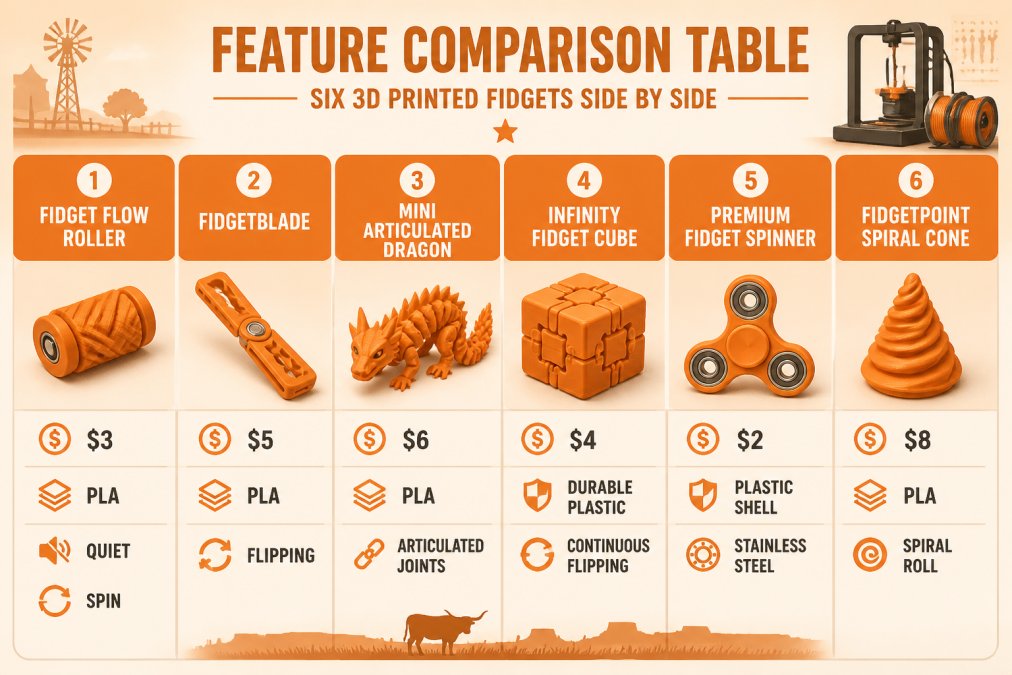
Feature Comparison Table: Six 3D Printed Fidgets Side by Side
Every fidget in our shop solves a different problem. The table below shows which one fits your hands and habits. Prices are one-time purchases, and every item is made to order.
| Fidget | Price | Material | Mechanism | Best For |
|---|---|---|---|---|
| Fidget Flow Roller | $3.00 | PLA | Quiet palm spin and finger roll | Meetings and desk work |
| FidgetBlade | $5.00 | PLA | Smooth butterfly flipping | Trick practice and EDC carry |
| Mini Articulated Dragon | $6.00 | PLA | Articulated joints, twist-open egg | Display plus tactile play |
| Infinity Fidget Cube | $4.00 | Durable plastic | Continuous flipping and folding | Classrooms and commutes |
| Premium Fidget Spinner | $2.00 | Plastic shell, stainless steel | Long smooth rotation | Budget everyday focus |
| FidgetPoint Spiral Cone | $8.00 | PLA | Spiral roll and spin | Rolling across a desk |
PLA vs PETG vs TPU: Material Science for 3D Printed Fidget Toys
Filament choice is a significant factor in how long a printed fidget survives. PLA is stiff and dimensionally accurate. The right pick depends on whether the mechanism needs stiffness or impact absorption.

- PLA: stiffest, best surface finish, tightest tolerances on small moving parts, ideal for snap-fit parts and thin articulated joints. Downsides: brittle under sharp impact and softens in a hot car.
Drop-Test Behavior: Why PLA Wins Some Fights and Loses Others
A common pattern: PLA survives thousands of cycles but fails on one bad drop. That is the trade-off between stiffness and toughness, not a defect.
- A PLA flipper printed with good layer adhesion feels crisp for months because the handles do not flex, but drop it on tile from pocket height and the handle can snap along a layer line.
Hinge Fatigue: The Failure Mode Nobody Talks About
Most printed fidget hinges are printed-in-place pin joints. Both fail from fatigue, not a single impact.
- Printed-in-place pin joints wear as the pin and bore rub together. PLA holds its bore diameter longest because it is stiff.
Temperature Reality Check
PLA begins to soften well below the temperatures a parked car reaches in summer sun. A PLA fidget left on a dashboard can warp enough to bind a joint or loosen a snap fit.
What We Actually Print In
Every TXMRB fidget is printed in PLA because our mechanisms depend on stiffness: a butterfly-style flipper needs rigid handles to rotate cleanly, and a spiral cone needs a firm surface to roll predictably. We compensate for PLA's brittleness with print orientation and infill choices rather than switching filaments.
Why Layer Adhesion Decides Whether a Fidget Breaks
Layer adhesion is the bond between each printed layer and the weakest point in any 3D printed part. When a fidget snaps, it almost always separates along a layer line rather than cracking through solid plastic.
Three settings control how strong that bond is:
- Print temperature: running slightly hotter improves bonding between layers
- Print orientation: orienting the part so stress runs across layers instead of between them
- Infill density: higher infill gives internal structure more material to grab onto
Ergonomic Testing for Different Hand Sizes
Fidgets are not one-size-fits-all, and hand size changes which design works for you. A fidget that disappears into a large palm feels clumsy in a smaller one, and one that fits a child's grip can cramp an adult's fingers.
Three measurements matter most:
- Palm width: determines whether a roller or spinner sits comfortably or feels lost
- Finger length: affects how easily you can reach a flipping mechanism without repositioning
- Grip strength: lighter, smaller fidgets suit lighter grips; heavier spinners suit firmer ones
Our Fidget Flow Roller and Premium Fidget Spinner are the most forgiving for smaller hands because both are compact and light. The FidgetBlade and FidgetPoint Spiral Cone reward a slightly larger grip, since the flipping and rolling motions need room to travel.

Review: Fidget Flow Roller, FidgetBlade, and FidgetPoint Spiral Cone
These three are our most popular printed fidgets, and each earns its place for a different reason. All three use PLA, come in ten colors, and are printed to order in Liberty Hill.
FidgetBlade: Smooth Flipping and Precision Tactile Feedback
The FidgetBlade is a 3D printed butterfly knife trainer with no blade and no sharp edges, built for smooth flipping and satisfying tactile feedback.
What works: the rotation is smooth, the weight sits evenly in the hand, and the lack of a blade means you can flip it anywhere.
Where it falls short: flipping is a skill. If you want something you can use without practice, this is not it.
FidgetPoint Spiral Cone and Fidget Flow Roller: Quiet Focus Tools
The FidgetPoint Spiral Cone and the Fidget Flow Roller are the two quietest fidgets we make. No clicking, no rattling. Both are desk and meeting friendly.
The spiral cone uses a tapered geometry that rolls, spins, and grips differently depending on how you hold it, making it the more interesting of the two to handle.
The Flow Roller is simpler and cheaper at $3.00, rolling between your fingers or spinning in your palm, and fits in a pocket without a bulge.
Mini Articulated Dragon, Infinity Fidget Cube, and Premium Fidget Spinner Reviewed
The remaining three cover the display end, the classroom end, and the budget end of the range.
Mini Articulated Dragon ($6.00) is the only fidget here that doubles as decor.

Infinity Fidget Cube ($4.00) is the one we would hand to a student.
Premium Fidget Spinner ($2.00) is the cheapest way into a printed fidget and the most familiar. The plastic shell paired with stainless steel components gives it a sturdy feel and smooth, consistent rotation.
Best Fidget Toys for Focus: Matching the Design to Your Needs
The best fidget toy for focus is the one that matches your fidgeting style, not the one with the most features. Repetitive motion helps many people hold attention, but the motion that helps you is specific to you.
Match the mechanism to the habit:
- If you click pens: choose the FidgetBlade for flipping action and tactile feedback
- If you bounce your leg: choose the Fidget Flow Roller for constant quiet motion
- If you pick at your nails: choose the Infinity Fidget Cube for continuous hand occupation
For ADHD focus and sensory processing, the goal is steady tactile feedback without pulling your eyes away from the task. Quiet, repetitive designs do that best.
How to Clean 3D Printed Fidget Toys Without Damaging Them
Clean 3D printed fidget toys with a dry or lightly damp cloth and mild soap, then let them air dry fully before use.
A workable routine:
- Wipe the surface with a dry microfiber cloth to lift dust and skin oils
- For sticky residue, dampen a cloth with water and a drop of mild dish soap
- Work around joints with a soft brush rather than forcing the mechanism open
- Dry completely, including inside articulated joints, before storing
- Store in a pocket, pouch, or the dragon egg shell to keep grit out of the moving parts
Two things shorten a printed fidget's life faster than anything else: heat and grit. PLA softens in a hot car, warping thin joints and loosening the fit, while sand and grit work into moving parts and grind surfaces down.
Fixing the Three Most Common Fidget Failures
Most printed fidgets do not need replacing when something goes wrong. They need ten minutes and a small tool.
1. A loose pivot or wobbly hinge. Printed-in-place pin joints loosen as the pin and bore wear against each other.
**2.
3. A spinner that has lost its spin time. This is almost always grit or a dry bearing, not a worn-out spinner.
When to Repair and When to Replace
A quick rule: repair if the failure is at a joint, pivot, or bearing. Replace if it is a structural crack through a solid section of the body, because that crack keeps propagating no matter how well you glue it. Articulated designs like the Mini Articulated Dragon are usually repairable at the joints since each link is a separate printed piece.
Preventing the Next Failure
- Keep grit out. A pocket or pouch beats a loose backpack pocket every time.
- Keep heat away. A glovebox in summer is the fastest way to warp a PLA fidget.
- Do not force a stiff joint. If a hinge suddenly feels tight, stop, inspect, and clean before pushing through it.
If a TXMRB fidget ever fails in a way you cannot fix at home, reach out through TXMRB.com and we will help you figure out the next step.
Frequently Asked Questions
Are 3D printed fidget toys durable enough for daily use?
It depends on the material and how the part was printed. PLA is the most common filament for 3D printed fidget toys because it produces a smooth surface finish and holds fine detail well, which matters for articulated designs and mechanical joints. Layer adhesion and infill density do more for durability than the filament label alone. A well-oriented print with solid walls handles pocket carry, desk drops, and constant flipping. TXMRB fidgets like the FidgetBlade and Fidget Flow are printed in PLA and made to order, so each one is built fresh rather than pulled from bulk stock.
How do 3D printed fidget toys help with focus and ADHD?
The mechanism is repetitive motion. Spinning, rolling, or flipping gives busy hands a steady outlet, which can reduce restless fidgeting and support concentration during meetings, study sessions, or long tasks. Many people use tactile feedback as a sensory anchor: the hands stay occupied while attention stays on the work. Quiet designs matter here, since a clicking toy in a shared office defeats the purpose. The FidgetPoint Spiral Cone and Fidget Flow Roller are both built for silent use, which makes them practical for classrooms, libraries, and desk work.
What materials are best for long-lasting 3D printed fidgets?
PLA is the standard for most 3D printed fidget toys. It prints with crisp detail, feels smooth in the hand, and holds up to normal handling when the print is solid. For a pocket fidget that mostly spins or flips, PLA is the practical choice.
Are 3D printed fidget toys safe for children?
Most are, with two checks first. Look for designs with no sharp edges, and confirm small parts are not loose enough to detach. The FidgetBlade is built as a trainer with no blade and no sharp edges, so kids and teens can practice flipping tricks safely. The Infinity Fidget Cube is made for kids and adults alike. For younger children, supervise use and avoid any fidget with joints that could separate. Also keep PLA pieces away from heat, since high temperatures can soften the material and affect joint tension.
How does 3D printing allow for unique fidget toy designs?
3D printing builds each piece layer by layer, so shapes that would be expensive or impossible to mold, like a spiral cone or an articulated dragon with dozens of moving joints, can be produced in small batches. It also makes customization practical: TXMRB fidgets come in 10 colors on several models, and custom color requests are available. Because items are made to order in Liberty Hill, Texas, each one is printed for the buyer rather than mass produced. That is the main difference between a handmade fidget and a generic molded one.