

Best Record Player for Beginners in 2026 Buyer's Guide
Last Updated: October 30, 2026
Quick Summary
For a first record player in 2026, choose a simple belt-drive turntable with 33⅓ and 45 RPM speeds, a stable adjustable tonearm, and a phono output that matches your speakers. Built-in speakers suit small rooms, while a separate setup suits better sound. Keep the unit on a level, stable surface.
- Look for both 33⅓ and 45 RPM speed settings on any model.
- Belt-drive turntables are the practical choice for most first-time buyers.
- Automatic models protect your needle from accidental drops while you learn.
- Check whether the turntable has a built-in phono preamp before buying.
- Keep a carbon-fiber brush and anti-static sleeves to protect your records.
Table of Contents
- What Makes a Record Player Right for Beginners
- Belt-Drive vs Direct-Drive Turntable: Which Fits a First Setup
- Record Player with Built-In Speakers: Convenience and Limits
- Record Player Setup for Beginners, Step by Step
- Turntable Accessories for Beginners Worth Considering
- Realistic Budget Tiers and Mistakes to Avoid
- Choosing Your First Record Player and Where to Start
- Frequently Asked Questions
Choosing a first record player in 2026 gets confusing fast. Turntables come with built-in speakers, Bluetooth, automatic arms and belt drives, and each feature changes what you need to buy around it. At TXMRB, we offer physical music and handmade gear, and we know how much a good first setup depends on the details. This guide walks through what matters for a beginner and how to avoid the common missteps.
What Makes a Record Player Right for Beginners
A beginner record player is a turntable that spins records reliably, tracks them cleanly, and does not demand technical know-how to set up. The best starting point is usually the simplest one that sounds good at your budget.
Focus on four things when you compare models:
- Speed settings: Look for both 33⅓ and 45 RPM, since most albums and singles use one or the other.
- Phono output: Check whether the unit includes a built-in phono preamp, or whether you'll need an external one to connect to powered speakers or a receiver.
- Tonearm and cartridge: A stable tonearm with an adjustable tracking force makes it easier to protect your records.
A simple, well-built turntable is often a better first purchase than a feature-heavy model you may never fully use.
Belt-Drive vs Direct-Drive Turntable: Which Fits a First Setup
Most entry-level turntables use one of two motor designs. A belt-drive turntable uses a rubber belt to connect a motor to the platter. A direct-drive turntable places the motor under the platter and turns it directly.
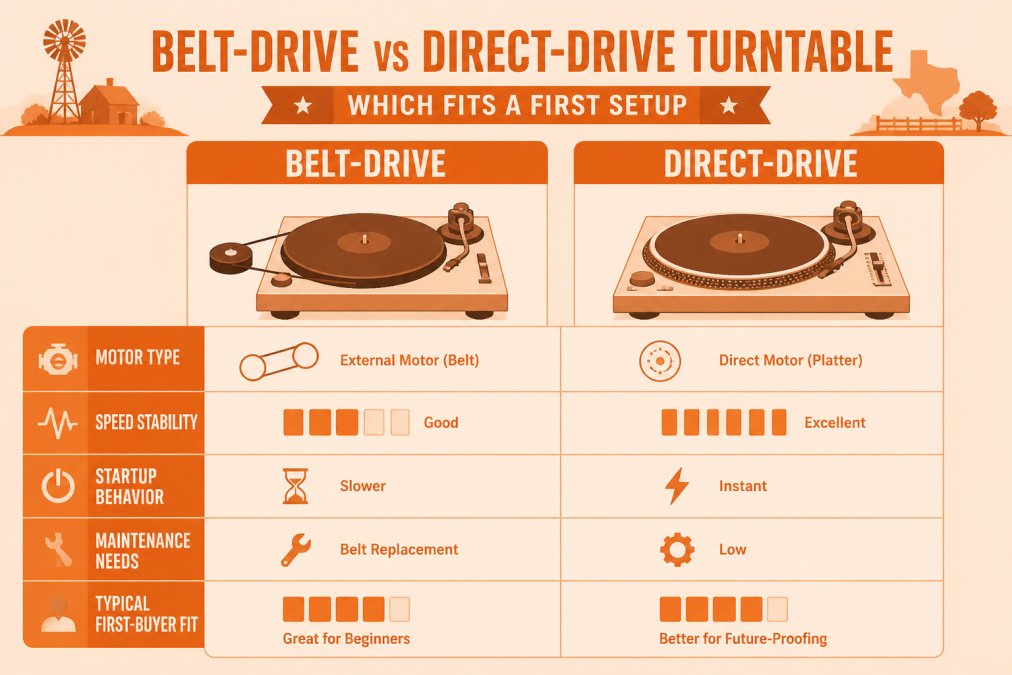
Belt-drive models are the more common choice for beginners. For a closer look at what quality handmade gear costs and why, see our guide to durable handcrafted picks.
Direct-drive models spin up quickly and hold steady speed, which suits DJs and people who scratch or cue records often.
For most first-time buyers, a belt-drive turntable is the practical pick. It is quieter, simpler to live with, and more forgiving of the small mistakes that come with learning.
Automatic vs Manual Operation for First-Time Buyers
An automatic turntable lifts the tonearm, places it on the record, and returns it to rest when the record ends. A manual turntable leaves all of that to you.
Automatic models are easier to use and protect your needle from accidental drops. Manual models give you more control over where the needle lands, which some listeners prefer. If you're new to vinyl, an automatic model removes a lot of the risk of scratching a record or damaging the stylus.
Record Player with Built-In Speakers: Convenience and Limits
A record player with built-in speakers is a complete system in one box. You plug it in, drop the needle, and listen. That convenience is appealing for a bedroom, a dorm room, or a small desk.
The limits are real, though. Built-in speakers are usually small, and they rarely match the clarity of separate speakers paired with a good turntable.
Built-in units make sense when simplicity matters more than audio performance.
Record Player Setup for Beginners, Step by Step
A basic setup takes less than an hour. Work through these steps in order:
- Place the turntable on a level, stable surface. Avoid speakers or shelves that vibrate, since bass can cause skipping.
- Attach the platter and drive belt. Follow the included instructions carefully, since the belt is easy to misplace.
- Balance and set the tracking force. Use the manufacturer's recommended range, usually shown in grams on the tonearm.
- Connect the output. Use the RCA cable to link the turntable to your speakers, receiver, or built-in phono preamp.
- Select the correct speed. Confirm 33⅓ or 45 RPM before you play a record.
- Lower the needle slowly. Use the cueing lever if your model has one, and never drop the arm onto the record.
A common mistake is skipping the level check. A tilted platter can cause uneven tracking and wear on your records over time.
Turntable Accessories for Beginners Worth Considering
A turntable is not a plug-in-and-forget device. The stylus touches every record you own, records accumulate dust and static, and the belt on a belt-drive deck stretches over time. The accessories below are the ones that commonly help extend the life of records and a turntable.
Cleaning and record care
- Carbon-fiber brush: Run it gently along the grooves before every play to lift loose dust. This is the single highest-value accessory for a beginner.
- Anti-static inner sleeves: Replace the paper sleeves many records ship in. Paper sheds fibers and scuffs the record surface; anti-static sleeves reduce both dust and static pops.
- Record cleaning solution and microfiber cloth: For deeper cleaning of used records. A common pattern is a light wet clean on arrival for any secondhand purchase.
Stylus replacement: the consumable beginners forget
Every stylus wears out. A diamond tip gradually flattens with use, and a worn stylus is one of the most common causes of distortion, sibilance, and accelerated record wear. Stylus life depends on the stylus profile, tracking force, and how clean your records are. Rather than track hours, watch for the signals:
- Distortion or harshness on passages that used to sound clean.
- Sibilance (a hissy, spitty quality on vocals and cymbals).
- Increased surface noise that cleaning does not fix.
Keep a spare stylus on hand so a worn tip does not sideline your listening. Check your turntable's manual for the correct replacement stylus model, styli are specific to the cartridge, so a generic replacement will not fit.
Belt and platter maintenance
On a belt-drive deck, the belt is a wear item. It stretches and can glaze over time, which shows up as speed instability or a slow start. Inspect it periodically, keep it free of oil and dust, and replace it when speed drifts. Keep the platter and spindle clean, and never force the platter by hand while the belt is engaged.
Tracking force and alignment
Recheck tracking force after moving the turntable or changing the cartridge. A small digital stylus gauge is inexpensive and far more accurate than the markings on the tonearm. Setting tracking force within the cartridge manufacturer's recommended range protects both your records and the stylus.
What you can skip at first
You do not need a record-cleaning machine, a clamp, or premium cables on day one. Start with a brush, anti-static sleeves, a stylus brush, and a spare stylus on the shelf. Add deeper cleaning tools only if you buy a lot of used records.
If you are building a physical collection alongside your setup, our Where to Buy Physical Music in 2026: A Collector's Guide covers sourcing new and used records, and How to Spot Counterfeit Physical Media: A Buyer's Guide helps you avoid poor pressings that make any stylus sound bad.
Realistic Budget Tiers and Mistakes to Avoid
Many beginner guides focus only on a turntable's sticker price. That number is only part of what you'll actually spend, because a turntable alone usually will not make sound. The honest way to budget is to price the complete system: the deck, the phono stage, the speakers, and the small accessories you'll want in the first month.
The four cost buckets in any first setup
Every beginner setup is built from the same parts. Knowing which ones your turntable already includes is what keeps the budget from ballooning.
- Turntable (deck + tonearm + cartridge): The core purchase. Some models include a built-in phono preamp; many do not.
- Phono stage (preamp): Needed if your turntable lacks one and your speakers or receiver do not have a dedicated phono input. This is the single most common surprise cost.
- Speakers or amplification: Powered speakers have the amplifier built in and accept a line-level signal. Passive speakers need a separate amplifier or receiver with a phono input.
Three realistic tiers to plan around
Rather than rely on exact prices, which change over time, think in tiers and check current pricing before you buy.
Tier 1, All-in-one convenience. A turntable with built-in speakers and a built-in preamp. One box, one power cable, no compatibility questions.
Tier 2, Deck plus powered speakers. A turntable with a built-in preamp feeding a pair of powered speakers.
Tier 3, Deck plus separate phono stage and amplifier. A turntable without a built-in preamp, an external phono stage, and a receiver or integrated amp driving passive speakers.
Mistakes that cost beginners the most
- Forgetting the phono stage. A turntable without a built-in preamp will sound thin or nearly silent through line-level speakers until you add one.
- Mismatching speakers and amplification. Powered speakers plus an external amplifier is a redundant purchase; passive speakers with no amplifier is a dead end.
- Buying the cheapest deck with a fixed, non-adjustable tonearm. You lose the ability to set tracking force correctly, which affects both sound and record wear.
A simple budgeting method
Write down your total ceiling first, then subtract in this order: speakers, phono stage (if needed), accessories, and finally whatever remains for the deck. Beginners who budget deck-first often discover the speakers and preamp push them over their limit. Budgeting system-first keeps the whole setup inside your number and makes the trade-offs visible before you commit.
Here is how the main costs stack up across a typical first setup, based on what the article describes.
| Cost bucket | What it covers | Watch for |
|---|---|---|
| Turntable | Deck, tonearm and cartridge | Some models lack a built-in preamp |
| Phono stage | Preamp for line-level inputs | Most common surprise cost |
| Speakers or amplification | Powered or passive speakers | Match speakers to the amplifier |
| Accessories | Brush, cleaning solution, sleeves | Plan for a spare stylus |
Choosing Your First Record Player and Where to Start
Start by deciding how you'll listen. A bedroom with built-in speakers calls for a different turntable than a living room with a receiver and floor speakers.
Next, think about where you'll buy records. Physical copies vary in quality, so learning to spot counterfeit or poor pressings will protect your money.
At TXMRB, we make original Texas country music available on physical CDs and handmade merchandise. For current product details and availability, visit TXMRB.com.
Frequently Asked Questions
What is the best record player for a beginner in 2026?
There is no single best model for everyone, but a strong first record player for 2026 is a simple, well-reviewed turntable with adjustable speed options, a removable or preset cartridge, and a clear path to adding external speakers or a phono preamp later. Focus on ease of setup and build quality rather than extra features you may never use. Compare current listings at the retailer you plan to buy from, and check that the included tonearm and cartridge suit your listening habits before you commit.
Do beginner record players need external speakers?
Not always. Many beginner record players include built-in speakers, which makes them convenient for a bedroom or small desk. Built-in speakers are generally limited in volume and depth, so they suit casual listening best. If you plan to listen seriously or in a larger room, a pair of powered or passive speakers paired with a phono preamp will usually improve the sound more than an upgrade to the turntable alone.
Is a belt-drive or direct-drive turntable better for beginners?
Both can work well for beginners. Belt-drive turntables are often valued for quieter operation and lower motor noise, while direct-drive models start playing quickly and handle DJ-style use well. Belt-drive designs usually need a belt replacement eventually, so check the maintenance expectations before buying. Choose based on whether you want quiet, traditional playback or fast startup and durability for frequent use.
What accessories do you need with your first turntable?
At minimum, a beginner often needs a record cleaning brush, a stylus cleaning tool, and a dust cover if the turntable does not include one. Depending on your setup, you may also need speakers or an amplifier, RCA cables, and a phono preamp if the turntable does not have one built in. Keeping these basics on hand helps protect your records and your stylus from early wear.
