

Durable Handcrafted Gear for Men: 7 Picks That Last
Table of Contents
- Quick Comparison: Durable Handcrafted Gear for Men
- How to Identify Quality Handmade Goods Before You Buy
- 1. TXMRB Heavyweight Fleece Hoodie: Built for Cold Shows and Long Days
- 2. TXMRB Wool Blend Structured Cap: Shape Retention That Survives the Truck Dash
- 3. TXMRB Performance Tee: Moisture-Wicking Gear for Working Outside
- 4. TXMRB Bags: Duffel, Honeycomb Backpack, and Cinch Pack Compared
- 5. TXMRB 3D-Printed Fidgets and Dog Tags: Small Gear, Real Wear
- The Benefits of Supporting Independent Artists When You Buy Gear
- Frequently Asked Questions
Last Updated: October 2, 2026
Quick Comparison: Durable Handcrafted Gear for Men
Durable handcrafted gear for men is clothing and accessories made in small batches by an independent maker, built from heavier materials and reinforced construction to hold up to daily use. At TXMRB, every piece is designed and made to order in Liberty Hill, Texas, the person who prints your fidget wrote the song on the QR tag.
Here's what we make, what it's built from, and who each piece suits.
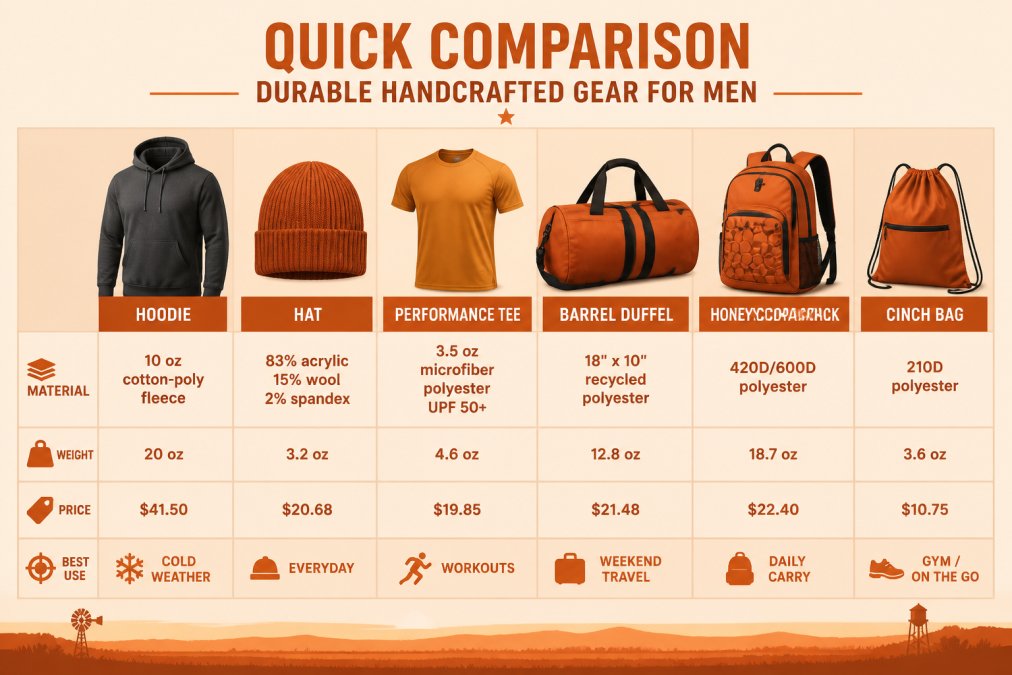
| Item | Material | Price | Best For |
|---|---|---|---|
| Heavyweight Fleece Hoodie | 10 oz cotton-poly fleece | $41.50 | Cold shows, layering |
| Wool Blend Structured Cap | 83% acrylic, 15% wool, 2% spandex | $20.68 | Everyday wear |
| Performance Tee | 3.5 oz microfiber polyester, UPF 50+ | $19.85 | Working outside |
| Barrel Duffel | 18" x 10" recycled polyester | $21.48 | Weekend travel |
| Honeycomb Backpack | 420D/600D polyester | $22.40 | Daily carry |
| Cinch Pack | 210D polyester | $13.77 | Grab-and-go |
| Fidgets and Dog Tag | PLA | $3.00-$5.00 | Desk and everyday carry |
How to Identify Quality Handmade Goods Before You Buy
Quality handmade goods show three things you can check in under a minute: material weight, construction details, and whether the maker will say where the materials come from.
![[TXMRB] Hoodie — Heavyweight Fleece Pullover](https://cdn.shopify.com/s/files/1/0608/6731/3751/files/ninjapod_13143069_f_4719_60_f.jpg?v=1783158316)
Fabric weight in ounces or denier. Ounces per square yard (oz/yd²) measure knit and fleece density; denier measures fiber thickness in woven goods. A 10 oz fleece holds its shape, and 600D polyester resists abrasion better than 210D at high-friction spots like strap anchors and base panels.
Fiber blend, not just fiber name. Pure cotton feels great and shrinks; a 60/40 cotton-poly blend resists shrinking and holds color longer. A small percentage of spandex lets a structured cap move with your head without losing its crown.
![[TXMRB] Hat — Wool Blend Structured Cap](https://cdn.shopify.com/s/files/1/0608/6731/3751/files/ninjapod_13143029_f_6477_44_f.jpg?v=1783158316)
Stitch density and reinforcement. Look for stated construction details, like eight-row stitching on a cap bill or raglan shoulder insets on a tee.
Hardware that matches. Color-matched zippers, detachable straps, and consistent finish signal a maker who thought past the fabric order.
A named material source. If a listing names the base garment it is built on, that is a maker who is not hiding the supply chain. Federal Trade Commission guidance on made in USA and textile labeling explains what those claims are legally allowed to mean, which helps you read labels critically instead of taking them at face value.
Made-to-order timing. A stated production window tells you the item isn't sitting in a warehouse.
A quick stress-test mindset
You cannot run lab tests in a store aisle, but you can predict where a piece will fail. Flex the fabric hard at the seam and watch for stitch pull. Rub a bag's base panel against a rough surface and see whether the weave fuzzes. Twist a cap bill and check whether it springs back. These three moves surface most construction weaknesses before you spend anything.
1. TXMRB Heavyweight Fleece Hoodie: Built for Cold Shows and Long Days
This one is built on the Bella + Canvas 4719 Unisex 10 oz heavyweight hoodie, made from Airlume combed and ring-spun 60% cotton, 40% polyester fleece. The 10 oz weight keeps you warm without a jacket's bulk, and the brushed fleece lining is comfortable against bare arms.
The details earn its keep. A double-layer hood with no drawcord gives warmth. Ribbed cuffs and waistband hold their shape wash after wash, and set-in sleeves with a slightly dropped shoulder layer easily over a tee and under a jacket.
Sizes run XS through 4XL, so this isn't a one-size-fits-most situation.
Pros: Heavy 10 oz fleece, double-layer hood, tear-away label, wide size range. Cons: No drawcord on the hood, which some buyers want for wind.
Textile fiber and care labeling requirements from the FTC are worth a skim if you want to understand why a 60/40 cotton-poly blend resists shrinking better than pure cotton.
2. TXMRB Wool Blend Structured Cap: Shape Retention That Survives the Truck Dash
This one is built on the Flexfit 6477 profile from 83% acrylic, 15% wool, and 2% spandex, a blend chosen for warmth and stretch that moves with your head.
Construction is the selling point. A six-panel structured crown with hard buckram backed front panels keeps a crisp silhouette, and eight-row stitching on the bill adds durability. Sewn eyelets let air move, the spandex sweatband holds shape, and a silver underbill cuts glare.
Available in S/M and L/XL, both with a 3½" crown height.
Pros: Structured crown, eight-row bill stitching, glare-reducing underbill. Cons: Only two size bands, so fit is less adjustable than a snapback.
3. TXMRB Performance Tee: Moisture-Wicking Gear for Working Outside
This tee is built on the Paragon 200 Islander from 3.5 oz microfiber performance polyester, with Paragon Plus odor and moisture control to keep you dry as the day heats up. Heather Grey runs heavier at 4.7 oz.
Two specs stand out for working in the sun.
Sizes run XS through 4XL.
4. TXMRB Bags: Duffel, Honeycomb Backpack, and Cinch Pack Compared
Three bags, three jobs, and the differences come down to material weight and how you carry them.
5. TXMRB 3D-Printed Fidgets and Dog Tags: Small Gear, Real Wear
Small gear gets lost, sat on, and dropped in parking lots. These pieces are printed to order from PLA, lightweight, strong, and smooth in the hand.
The Benefits of Supporting Independent Artists When You Buy Gear
Buying from an independent maker changes what you receive: gear made in small batches, a person who answers your questions, and money that stays with the artist instead of a distribution network. The benefits show up in the product, more willingness to customize, and a maker who stands behind the work because their name is on it.
The lifetime care advantage
Independent gear is designed to be kept, and keeping it means caring for it. Here's how to make handcrafted pieces last.
Why this matters for independent makers
When you buy from a small maker, you are not just buying a product, you are buying access to the person who made it. That means you can ask how to repair a seam, how to clean a specific fabric, or whether a part can be replaced instead of the whole piece. U.S. Small Business Administration resources on supporting local businesses outlines why small independent operations matter to local economies, and that logic applies to makers just as much as storefronts.
Frequently Asked Questions
Why is handcrafted gear often more durable than mass-produced alternatives?
Handcrafted and small-batch gear usually gets more attention at the points that fail first: stitching, hardware, and material choice. A 10 oz heavyweight fleece hoodie holds its shape through repeated washing, an eight-row stitched cap bill resists fraying, and a 600D polyester backpack panel handles daily abrasion. When one person or a small shop builds an item, those corners are usually the last thing cut.
How can you tell if a product is truly handcrafted?
Look for specifics rather than vague claims. A real maker will name the base garment or material, list exact weights and measurements, and explain how the item is finished. TXMRB, for example, states that its fidgets are 3D printed to order in Liberty Hill, Texas, and ships in 2-5 business days. Ask where the item is made, who makes it, and what happens if it arrives damaged. Vague answers, stock photos that appear on dozens of storefronts, and no named location are the usual signs of drop-shipped goods.
What materials should you look for in durable men's accessories?
Match the material to the job. For bags, look at denier: 210D polyester suits light day use, while 420D and 600D handle heavier loads and abrasion. For cold-weather layers, a 10 oz cotton-poly fleece balances warmth and shape retention. For hot-weather work, a 3.5 oz microfiber polyester with moisture control and UPF 50+ protection keeps you drier. For small 3D-printed pieces, PLA is lightweight and holds crisp detail, but keep it away from high heat and direct flame.
What are the benefits of supporting independent artists when buying gear?
Your money goes to a person, not a warehouse. Independent artists like Michael at TXMRB design, print, and ship their own work, so feedback reaches the maker directly and small runs can be customized. You also get pieces tied to an actual story: TXMRB bags carry a QR code that links to the music behind the brand. The trade-off is smaller inventory and made-to-order timelines, so plan ahead if you need something by a specific date.
How do you care for handcrafted gear so it lasts?
Wash heavyweight fleece and performance tees inside out in cold water and air dry when you can. Spot clean structured caps instead of machine washing. Wipe 3D-printed PLA items with a soft cloth and store them somewhere cool and dry, away from prolonged heat or direct flame. Check hardware, straps, and stitching a few times a year.
Buying durable gear shouldn't mean guessing whether it will survive the first wash or the first road trip. TXMRB builds every piece to order in Liberty Hill, Texas, from a 10 oz heavyweight fleece hoodie and a wool blend structured cap to a honeycomb backpack and 3D-printed fidgets that hold up to daily pocket abuse. Browse the full lineup at TXMRB.com and pick the piece that fits how you actually live.