

Why Handmade Drinkware Accessories Make Better Gifts
Last Updated: November 1, 2026
Quick Summary
Handmade drinkware accessories make better gifts because they combine daily utility with a personal story no mass-produced item can match. A handmade drinkware accessory is a maker-produced item designed to hold, carry, or protect a drinking vessel, and small runs mean your recipient is unlikely to see the same piece elsewhere.
- Match the piece to what the person actually drinks: coffee points to a mug, canned drinks to a sleeve.
- Can sleeves are inexpensive, solve a real annoyance, and photograph well as gifts.
- Keep personalization simple: a first name, initials, or a short phrase beats a long quote.
- Pass care instructions along with the gift, such as hand-wash only and don't leave it in the car.
- Order earlier than feels necessary, since handmade small batches leave less slack in the schedule.
Table of Contents
- Why Handmade Drinkware Accessories Make a Gift People Keep
- The Benefits of Buying Handmade Gifts
- Handmade Drinkware Gifts for Everyday Use
- How to Choose a Handmade Gift Without Guessing
- How to Judge Handmade Quality and Safety Before You Buy
- Material and Care Guidance for Handmade Drinkware
- Packaging, Shipping, and Fragile-Item Gifting
- Price, Value, and Lead Times on Handmade Drinkware
- Frequently Asked Questions
Why Handmade Drinkware Accessories Make a Gift People Keep
Most gifts get used once and forgotten. A handmade drinkware accessory gets used every morning, which is exactly why it stays.
A handmade drinkware accessory is a maker-produced item designed to hold, carry, or protect a drinking vessel, such as a can sleeve, a custom mug, or a fitted bottle holder.
That is the core argument of this guide. For a curated look at actual pieces to browse and buy, see our handcrafted gifts from Texas artists gift guide. Handmade wins not because it is prettier, but because it is specific.
The Benefits of Buying Handmade Gifts
Buying handmade changes who receives your money. When you buy from an independent maker, you support a small business and an independent creator.
The practical benefits stack up quickly:
-
One-of-a-kind character. Small runs mean your recipient is unlikely to see the same piece on a coworker's desk.
-
Local craft. Supporting independent makers keeps design and production close to home.
-
A story to tell. "The artist made this himself" lands better than "it was on sale."
If you want to understand the wider ripple effect of that choice, our piece on the benefits of supporting independent artists breaks down what independent makers contribute and why small purchases matter.
Handmade Drinkware Gifts for Everyday Use
A gift that sits in a cabinet is a failed gift. Handmade drinkware gifts work because they attach to a habit the recipient already has: coffee, water, soda, or a canned drink at the end of the day. Match the piece to the ritual and the gift gets used daily.
Durability matters more than decoration here. A well-made accessory should survive being tossed in a bag, rinsed in a sink, and knocked off a table.
Mugs, Tumblers, Bottles, and Sleeves: Matching the Piece to the Person
The fastest way to pick wrong is to shop by looks. Shop by what the person actually drinks from.
| Vessel Type | Best For | What to Check |
|---|---|---|
| Ceramic mug | Home coffee and tea drinkers | Glaze coverage, handle comfort, dishwasher guidance |
| Tumbler | Commuters and desk workers | Lid fit, base stability, insulation claims |
| Water bottle | Gym-goers and hikers | Seal integrity, cap thread, weight |
| Can sleeve | Soda and energy drink fans | Can size fit, adapter design, grip |
| Wine glass or glassware | Hosts and dinner-party givers | Rim finish, packaging protection |
Can sleeves are the sleeper gift in that list. They are inexpensive, they solve a real annoyance, and they photograph well. Our 3D printed Jack-O'-Lantern can sleeve kit is a good example of the category: one 16 oz sleeve with an included reversible adapter for smaller cans, plus a half-lid drink cover that clips on to help keep bugs, flies, dust, and debris away from the drink.

Personalization That Fits the Recipient
Personalization is the difference between a nice object and their object. A name, a short message, or a chosen design turns a mug into a possession. Keep it simple: a first name, initials, or a phrase the person actually says.
The mistake is over-personalizing. Long quotes crowd small surfaces, and inside jokes age badly. A single word or a design that matches their hobby usually beats a paragraph.
How to Choose a Handmade Gift Without Guessing
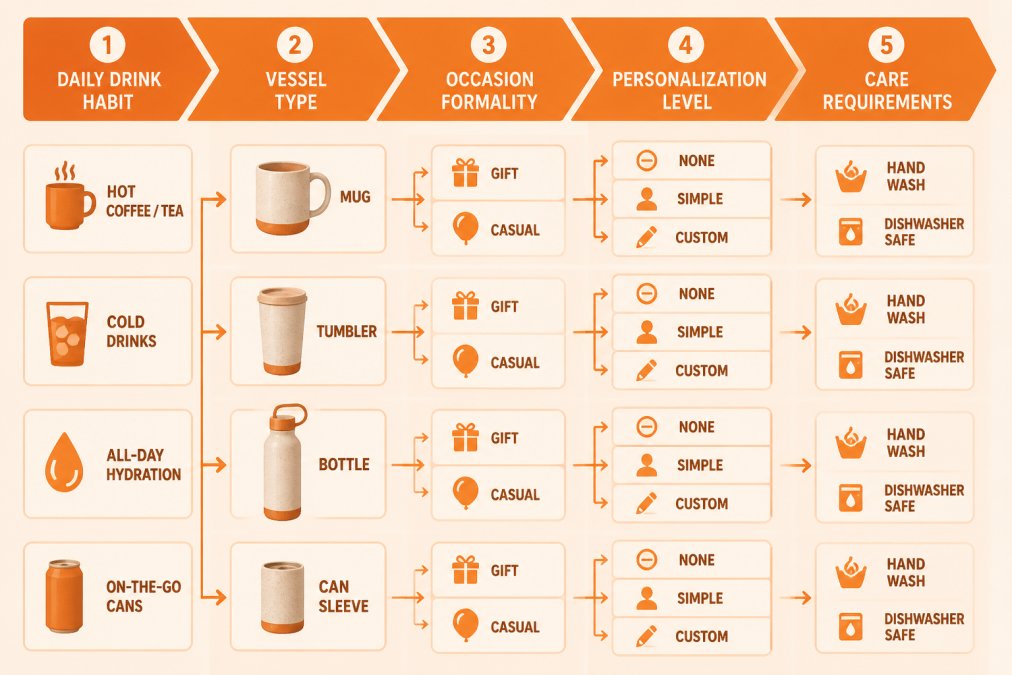
Stop guessing and start narrowing. Choosing a handmade gift is a process of elimination, not inspiration. Work through four questions in order and the answer usually picks itself.
Occasion and Recipient: A Simple Selection Framework
Use this framework and you can shop in minutes instead of hours:
- What do they drink daily? Coffee points to a mug, water to a bottle, canned drinks to a sleeve.
- Where do they drink it? Desk, car, gym, or couch changes the durability and lid requirements.
- How formal is the occasion? A housewarming tolerates a bold design; a workplace exchange usually calls for something quieter.
- How much personalization is appropriate? Close friend, full name. Acquaintance, a design only.
- Will they actually care for it? Hand-wash-only pieces go to people who will hand-wash.
Watch out: the biggest error is buying the piece you would want. A minimalist will not use a bright novelty sleeve, no matter how well it is made.
How to Judge Handmade Quality and Safety Before You Buy
Quality in handmade goods shows up in the details you can inspect in photos and in person. Look at the finish first.
Then check the parts that touch the drink. A can sleeve or drink cover should fit securely, sit level, and have no sharp edges near the mouth area. For a deeper walkthrough of what separates careful printing from careless printing, see our guide on how to spot quality 3D prints.
A common mistake is judging only the product photo. Ask for a real-world shot or check whether the listing shows the item in use. Makers who are proud of their work usually show it.
Material and Care Guidance for Handmade Drinkware
Most handmade-gift guides stop at "hand wash it." That advice is incomplete, because the material decides what care actually means. A ceramic mug, a glass tumbler, a metal bottle, and a 3D-printed sleeve fail in different ways, and a gift lasts only when it is cared for on the maker's terms for that specific material.
Here is how the common drinkware materials compare on the things that matter for a gift:
| Material | Heat behavior | Washing | Common failure mode | What to confirm with the maker |
|---|---|---|---|---|
| Ceramic | Tolerates hot drinks well; sudden temperature swings can stress it | Often dishwasher-safe, but glaze and applied designs may not be | Chips at the rim; crazing in the glaze over time | Whether the glaze is food-safe and whether the piece is dishwasher- and microwave-safe |
| Glass | Handles heat unevenly; thermal shock can crack it | Usually hand-wash for decorated or thin-walled pieces | Cracks from temperature change or knocks | Whether it is tempered and how it should be packed and stored |
| Metal (stainless, enamel) | Good for hot and cold; enamel can chip | Often dishwasher-safe unless coated or printed | Dents, enamel chips, faded exterior finishes | Whether the interior coating is intact and food-safe |
| 3D-printed plastic | Softens or warps with high heat | Hand-wash unless the maker says otherwise | Warping in hot cars or dishwashers; worn surface texture | Filament type, heat limits, and whether the piece touches the drink directly |
A few principles hold across all of them:
- Follow the listing, not your habits. If the maker says hand-wash, hand-wash. Heat and harsh detergent degrade applied designs, glazes, and printed finishes faster than anything else.
- Keep fitted parts out of the dishwasher. Adapters, lids, and covers warp and colors fade, and small parts are easy to lose.
- Dry fully before storing, especially pieces with recessed areas where water can sit and encourage odor or finish wear.
- Store sleeves and covers assembled so adapters do not disappear into a drawer.
- Avoid leaving pieces in a hot car. This is the single most common way printed plastic and applied finishes fail.
When in doubt, ask the maker directly. A short message about cleaning is normal and welcome, and a maker who answers clearly is usually a maker who knows their material.
Packaging, Shipping, and Fragile-Item Gifting
What to look for:
- Rigid outer box rather than a soft mailer for anything breakable.
- Cushioning around glass and ceramic, with the item unable to shift.
- Small parts bagged separately, so adapters and covers do not rattle against the main piece.
- A stated handling window, so you know whether the item ships in days or weeks.
If you are ordering close to a date, order earlier than feels necessary. Handmade means small batches, and small batches mean less slack in the schedule. Keep the packaging until you have inspected the item, since original packaging makes any return far easier.
Price, Value, and Lead Times on Handmade Drinkware
What you pay for is not just the object; it is the attention behind it, and that attention is what makes the gift specific rather than generic.
Value shows up over years, not at checkout. A piece that gets used daily for a long stretch costs very little per use, while a cheap item that breaks or gets abandoned costs the full price for nothing. That is the real comparison, and it is the one most gift guides skip.
Lead times follow the same logic. A maker who quotes a realistic window is usually a maker who plans their production. Handmade means small batches, and small batches mean less slack in the schedule, so a few practical habits keep a gift from arriving late:
- Order earlier than feels necessary. If a date matters, build in a buffer rather than assuming a fast turnaround.
- Read the stated handling window. It tells you whether the item ships in days or weeks, and it is usually more accurate than a shipping estimate alone.
If the price still feels high, our breakdown of why handmade items cost more walks through the real costs behind handmade pricing so you can compare fairly. And if you are weighing a handmade piece against a store-bought one, our guide to the benefits of supporting independent artists explains what that choice supports.
Frequently Asked Questions
What makes handmade drinkware a thoughtful gift?
A handmade piece carries the maker's decisions in it: the shape, the finish, the small variations that show a person made it rather than a machine. That matters because drinkware is used daily, so the gift stays in sight instead of sitting in a drawer. Pair it with the recipient's actual habits, like a can sleeve for someone who always has a sparkling water in hand, and the gift reads as attention rather than expense.
How do I choose a drinkware gift for someone?
Start with what they already drink and how they drink it. Coffee at a desk points to a mug; commuting points to a tumbler or bottle; canned drinks point to a sleeve. Then match the occasion: a casual exchange suits something playful, while a milestone calls for a cleaner design. Finally, check care requirements so the recipient is not handed a piece that needs special handling they will not do.
Are handmade drinkware gifts more personal than store-bought ones?
They tend to be, because the options are narrower and more specific. A mass-market tumbler comes in whatever colors the retailer stocked; a handmade piece comes in the shapes and finishes one maker chose to produce. That constraint is the point. You are picking from a small, deliberate set rather than a catalog, and the recipient can tell the difference between a gift chosen from a wall of identical options and one chosen from a handful.
What should I consider when buying handmade drinkware as a gift?
Check three things: whether the piece fits how the recipient actually drinks, whether the maker describes materials and care clearly, and whether the listing matches what you expect. Ask about lead times too, especially near holidays. A maker who answers those questions directly is usually a safer gift source than one who only posts finished photos.
