

Which Silent Fidget Toys Suit Open Office Plans?
Last Updated: October 24, 2026
Quick Summary
Silent fidget toys for open office plans are rollers, cubes, and smooth spinners that rely on continuous motion instead of impact, so they produce no distinct click, snap, or rattle at arm's length. Test any fidget for two full minutes in your quietest room before bringing it to your desk.
- A fidget is office-quiet when you hear no click, snap, or rattle at arm's length.
- Rollers, cubes, and smooth spinners are quietest because they use continuous motion, not impact.
- Keep the fidget below desk level, use slow motions, and put it away when you speak.
- Wipe hard-surfaced fidgets with a dry or lightly damp cloth regularly.
- A worn bearing gets louder before it fails, so noise warns you of wear.
Table of Contents
- Why Open Office Plans Need Silent Fidget Toys
- How to Test Whether a Fidget Is Truly Office-Quiet
- Quiet Fidget Toys for Adults: What Actually Works at a Desk
- Discreet Fidget Toys for Work: Matching the Tool to Your Space
- Fidget Toys for Focus at Work: What the Evidence Supports
- Under-Desk Fidgets and Keeping Your Hands Out of Sight
- Etiquette, Hygiene, and Durability for Shared Workspaces
- Choosing Your Office Fidget from TXMRB
- Frequently Asked Questions
Why Open Office Plans Need Silent Fidget Toys
A 2021 paper on fidget spinners and classroom behavior, published through the National Library of Medicine, cites a 2007 study where students were off task less often when using a quiet fidget toy attached to their desk.
Silent fidget toys for open office plans solve a specific problem. They give restless fingers something to do without adding clicks, snaps, or rattles to a room where everyone can hear everyone.
Here's what most guides get wrong: they recommend quiet fidget toys for adults without explaining how to check whether one is actually quiet.
How to Test Whether a Fidget Is Truly Office-Quiet
A fidget is office-quiet when it produces no distinct click, snap, or rattle during normal use at arm's length. Test it in the quietest room you have before you bring it to work.
Try this sequence:
- The library test. Use the fidget for two full minutes in the quietest room in your home. If you can hear it over ambient room tone, coworkers will hear it too.
- The arm's-length test. Hold it at arm's length and cycle through every motion it offers. Any sound you catch at that distance will carry across a shared desk cluster.
- The hard-surface test. Use it on a bare desk, not a mousepad. Rolling and tapping sounds change completely on a hard surface.
- The two-minute boredom test. Quiet fidgets fail when you get bored and start using them harder. Speed up and see what happens.
A common mistake is testing a fidget while music or a podcast plays. You'll miss the exact sounds that bother people most.
Quiet Fidget Toys for Adults: What Actually Works at a Desk
Rollers, cubes, and smooth spinners tend to be the quietest options because they rely on continuous motion instead of impact.
That matches what we hear from people who use fidgets at a desk all day: the quieter the mechanism, the less you think about it.
If you're shortlisting options, our roundup of the best fidget toys for office focus covers desk-appropriate picks in more detail.
The texture matters too. A textured surface with haptic bumps gives your fingers feedback without sound, which is why silicone and smooth 3D-printed finishes show up so often in low-noise designs. Metal looks premium but rings against a desk.
Discreet Fidget Toys for Work: Matching the Tool to Your Space
The right discreet fidget depends less on your preference and more on where you sit and what you're doing. A shared desk cluster has different rules than a private cubicle, and a meeting room has different rules than both.
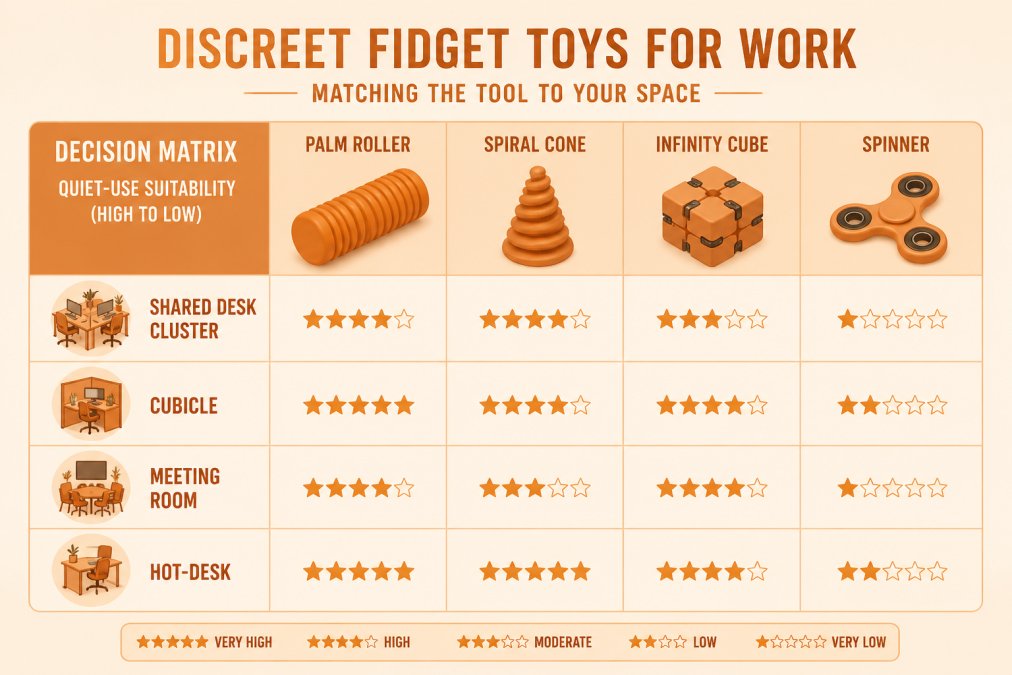
Here's how we'd match them, situation by situation:
- Shared desk cluster: a palm roller. Continuous rolling motion stays in your hand and out of earshot, and the motion is small enough that a neighbor glancing over sees a closed hand rather than a spinning object. Keep it in your lap or at the edge of the desk, not in the middle where it draws the eye.
- Private cubicle: a spiral cone or cube. You have more latitude on visibility, but keep it off hard surfaces. A cube flipped quietly over a mousepad is nearly inaudible; the same cube on a bare laminate desk produces a distinct tap on every flip.
- Meeting room: a small cube used under the table. Out of sight, minimal motion, and easy to pocket the moment the meeting ends. Avoid anything that requires two hands or a wide motion, you'll be visible on camera if the meeting is hybrid.
- Hot-desk or shared table: a compact roller that lives in your pocket and never sits on the desk. The advantage here isn't just quiet; it's that nothing is left behind for the next person to find or for you to forget.
- Phone and video calls: a palm roller or a smooth ring. Calls are the highest-risk situation because you're stationary and your hands are free, which is exactly when people start clicking a pen or drumming a desk. A roller gives your fingers a continuous outlet without a discrete sound. Avoid anything with a click dome, the microphone picks up sharp transients more than continuous motion.
- Commuting and between-meeting transitions: a pocket-sized cube or roller. The goal here is portability and durability rather than silence, since a train or sidewalk has plenty of ambient noise. A tool that survives being jostled in a bag without cracking is the priority.
A useful rule of thumb: the more visible and stationary you are, the smaller and smoother the fidget should be. The more private and mobile you are, the more you can trade silence for satisfying feedback.
Our 3D printed fidget roller sensory tool is built for exactly this: compact, smooth, and quiet, with no clicking or noise. It comes in ten colors and is printed to order in PLA.

Fidget Toys for Focus at Work: What the Evidence Supports
The honest answer is that the evidence for fidget toys improving focus at work is thin. The strongest study available looks at students in classrooms, not adults in open offices.
The 2021 PMC paper on fidget spinners and on-task behavior is worth reading in full if you want the details: the study on fidget spinners and on-task classroom behavior.
What we can say is narrower. Many people find a quiet, repetitive motion gives restless fingers somewhere to go during long tasks. That's a reasonable reason to try one.
If you want a deeper look at stress and focus techniques, our guide on how to manage stress with fidget toys goes further.
Under-Desk Fidgets and Keeping Your Hands Out of Sight
Under-desk fidgets work because they remove the visual distraction as well as the noise. A tool your coworkers can't see is a tool they can't be annoyed by.
The practical rule: keep the fidget below desk level, use slow motions, and put it away when you're speaking to someone.
Our infinity fidget cube is a good fit for this use. It's compact enough to slip into a pocket, built from durable materials, and designed for quiet, continuous motion.

Watch out: dropping a fidget on a hard floor in a quiet office is the single most noticeable thing you can do with one. Keep a firm grip or use it over your lap.
Etiquette, Hygiene, and Durability for Shared Workspaces
Three things keep a fidget welcome at work: it stays quiet, it stays clean, and it doesn't fall apart. All three are manageable with a little routine, and none of them require you to announce to your team that you use a fidget.
Etiquette without disclosure. You don't owe anyone an explanation for using a sensory tool, and many people use fidgets for reasons they'd rather not discuss at work. The practical middle ground is to keep the tool discreet and let the behavior speak for itself. A few habits cover most situations:
- Ask the people nearest you, once, whether they can hear it. A simple "can you hear this?" is less awkward than a coworker quietly resenting a click for three months.
- Put the fidget away during one-on-ones, presentations, and any conversation where you're the one speaking. The tool is for your focus, not a prop.
- Keep motions small and slow. Speed is what turns a quiet fidget into a noticeable one.
- If someone does mention it, treat it as information rather than criticism. Switching tools or switching hands usually resolves it.
Hygiene. A fidget lives in your hand for hours, so treat it like a pen or a phone rather than a desk ornament. Wipe hard-surfaced fidgets with a dry or lightly damp cloth regularly, especially if the tool is shared or moves between your desk and your bag. Wash your hands before use if you're handling food at your desk.
Durability. Check for loose parts, cracks, or wobble every few weeks. For a practical durability checklist before you buy, see our guide on how to choose durable fidget toys that actually last. A worn bearing gets louder before it fails, so noise is often your first warning that a part is on its way out. Pay attention to three specific wear points:
- Bearings and pivots, listen for a new rattle or a rougher spin. That's wear, not a quirk.
- Printed seams and layer lines, a hairline crack at a seam will widen with use and can eventually pinch.
- Surface finish, a glossy finish that turns tacky or chalky is telling you the material is breaking down, which is also when it starts collecting residue.
Choosing Your Office Fidget from TXMRB
The best silent fidget for an open office is the one you'll actually use quietly, consistently, and without thinking about it. Start with a compact roller or cube, test it in a silent room, and adjust based on your seating situation.
| Fidget | Price | Best For | Quiet Rating |
|---|---|---|---|
| Fidget Flow roller | $3.00 | Shared desks, pockets | Very quiet |
| FidgetPoint spiral cone | $8.00 | Cubicles, home desks | Quiet |
| Infinity fidget cube | $4.00 | Under-desk, meetings | Very quiet |
| Premium fidget spinner | $2.00 | Private spaces | Moderate |
Every one of these is 3D printed by hand in Liberty Hill, Texas, made to order, and shipped within 2 to 5 business days. We're a small independent shop, so if you want a custom color, just reach out.
Frequently Asked Questions
What fidget toys are quiet enough for an open office?
Look for designs with no clicking, snapping, or rattling parts. A roller or palm spinner with a smooth continuous motion is usually the safest pick, and a spiral cone that rolls on a desk mat works too. Avoid anything with metal-on-metal contact or loose beads. TXMRB's Fidget Flow roller is built as a quiet fidget with no clicking, which makes it a reasonable starting point for a shared desk.
How do I know if a fidget toy is too noisy for a shared workspace?
Test it before you bring it in. Use it for two full minutes in a quiet room, then have someone stand about an arm's length away and tell you whether they can hear it. If they can, it is too loud for a shared workspace. Also try it on the surface you actually work on, since hard desks amplify taps and rolls that feel silent in your hand.
Can fidget toys help with focus at work?
The research is narrower than most product pages suggest. A 2021 paper on fidget spinners cites a 2007 study where students were off task less often when using a quiet fidget attached to their desk. That is classroom evidence, not a study of adults in open offices, so treat focus benefits as plausible rather than proven. Many people still find a quiet fidget helps them stay seated through long tasks.
Are discreet fidget toys appropriate to use in meetings?
Yes, if the motion stays low and silent. Keep the fidget below the table edge or in your lap, choose a design with no clicking parts, and avoid anything that rolls off and lands on the floor. A compact roller or a small cube works better in a meeting than a spinner you hold up at eye level. If you are unsure, mention it to your manager first.
Your open office doesn't have to choose between your focus and your coworkers' peace. TXMRB makes compact, quiet fidgets designed for real desks: a smooth palm roller with no clicking, a durable infinity cube small enough to keep out of sight, and a spiral cone with a textured feel that keeps restless fingers busy. Get started with TXMRB and find a desk companion that stays quiet when you need it to.
