

How to Manage Stress With Fidget Toys: A 2026 Guide
Table of Contents
- What Are Fidget Toys and How Do They Work?
- How to Manage Stress With Fidget Toys in Daily Life
- Best Fidget Toys for Focus and Concentration
- Benefits of Fidget Toys for Adults
- Mindful Fidgeting Techniques for Stress Relief
- How to Manage Stress With Fidget Toys at Work and School
- Choosing and Caring for Your Fidget Toy
- Conclusion
- Frequently Asked Questions
Last Updated: September 16, 2026
What Are Fidget Toys and How Do They Work?
Fidget toys are small handheld objects that give restless hands something to do, and learning how to manage stress with fidget toys starts with understanding why the habit works. They channel nervous energy into repetitive motion, giving your attention a place to land while the rest of your brain handles the task at hand.
When your hands are busy with a quiet, repetitive action, your mind has less room to spiral.
The Science Behind Fidgeting and Stress Relief
Fidgeting is a form of sensory regulation. Repetitive motion gives the nervous system steady tactile stimulation, which many people find calming the way a rocking chair or a walk can be. Occupational therapists call this proprioceptive input, feedback from muscles and joints that helps the body feel grounded.
How to Manage Stress With Fidget Toys in Daily Life
The most effective way to use a fidget tool is to pair it with a specific moment in your day rather than carrying it around hoping it helps. Stress builds in predictable places: the commute, the meeting before lunch, the hour when your inbox wins. Attach the tool to those moments and it becomes a habit.
Step-by-Step: Building a Fidget Routine
- Pick one high-stress moment in your day and name it out loud.
- Choose a tool that fits that moment. A quiet roller for meetings, a spinner for desk work, a cube for the car.
- Keep it in the same place every day so you never have to remember it.
- Use it for the full duration of that moment, not just when you feel overwhelmed.
- After one week, notice whether that moment feels different. If it does, keep going. If it doesn't, try a different tool.
Best Fidget Toys for Focus and Concentration
The best fidget toy for focus is the one that matches your fidget style, because a tool that feels wrong in your hand will not get used. Some people need continuous motion, some need a single satisfying click, and some just need something to roll between two fingers.

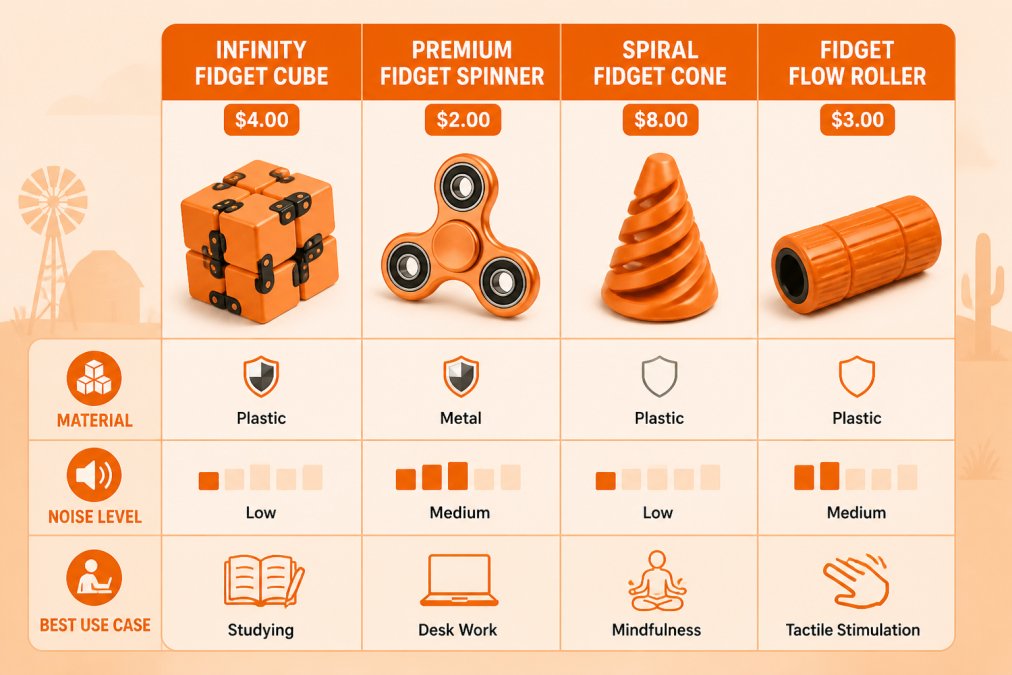
| Fidget | Price | Material | Noise Level | Best For |
|---|---|---|---|---|
| Infinity Fidget Cube | $4.00 | Durable construction | Quiet | Continuous flipping and folding |
| Premium Fidget Spinner | $2.00 | Plastic shell, stainless steel | Quiet | Long, smooth spins at a desk |
| Spiral Fidget Cone | $8.00 | PLA, 10 colors | Quiet | Rolling and gripping while thinking |
| Fidget Flow Roller | $3.00 | PLA | Quiet | Compact pocket carry |
Benefits of Fidget Toys for Adults
Adults get the same benefit from fidgeting that kids do, and it is worth saying plainly: this is not a children's habit. Nervous energy does not disappear with age, it just gets quieter, and most adults hide it by bouncing a leg or clicking a pen.


Mindful Fidgeting Techniques for Stress Relief
Mindful fidgeting means paying attention to the motion instead of doing it on autopilot. The tool stays the same; what changes is where your attention goes.
How to Manage Stress With Fidget Toys at Work and School
Discreet use is the key skill in professional and classroom settings, and it is the part most guides skip. The goal is a tool that moves quietly and stays in your hand or lap, not one that draws attention across the room. That means thinking about sound, sight line, and hand position.
Matching the Tool to the Setting
| Setting | Best fit | Why |
|---|---|---|
| Open-plan office | Roller or cone | Silent, one-handed, stays in your lap |
| Video calls | Roller | Off-camera, no motion visible on screen |
| In-person meetings | Cone or cube | Contained motion, no clicking |
| Classroom or lecture | Cube or spinner on the desk | Motion stays in one spot, easy to set down |
| Library or quiet study | Roller or cone | No sound at all |
| Commute or transit | Roller | Fits in a pocket, comes out without a scene |
For offices and meetings, a roller or cone works better than anything with visible spinning parts. Keep it below the table line, use slow motions, and pick a tool with no clicking or rattling. The Spiral Fidget Cone is quiet by design, which is why we recommend it for open-plan offices and libraries.
A Note on Video Calls
Remote work added a setting most fidget guides ignore. On a video call, the camera sees your hands even when the room does not. A roller used below the desk is invisible; a spinner held near your face is not. If you take a lot of calls, keep the tool in your lap and let your hand work out of frame.
Avoid fidget toys with loud clicking mechanisms or loose metal parts in a quiet room. The sound draws more attention than the motion ever would, and you will end up more self-conscious than calm.
If you are worried about how a tool looks at work, start with the quietest option you own and use it for a week before deciding. Most people find that once the motion is silent and below the table, no one notices at all.
Choosing and Caring for Your Fidget Toy
Choosing well comes down to three questions: where will you use it, how much noise is acceptable there, and what motion does your hand actually want? Answer those and the decision is usually obvious.
Match the Tool to Your Fidget Style
If you fidget by moving constantly, choose a cube or roller. Continuous motion suits long meetings and study sessions where your hands want ongoing work.
Tactile, Visual, or Auditory: Pick Your Sensory Type
Most fidget guides sort tools by shape. A more useful way to choose is by which sense the tool feeds, because people with different sensory needs get relief from different inputs.
- Tactile fidgets rely on touch: texture, weight, grip, and resistance. Rollers, cones, and stress balls fall here. If you calm down by rubbing fabric, holding a smooth stone, or squeezing something, a tactile tool is your match.
- Visual fidgets rely on watching motion: spinning, flipping, and flowing shapes. Spinners and cubes fall here. If you calm down by watching a ceiling fan, a lava lamp, or traffic, a visual tool is your match.
- Auditory fidgets rely on sound: a soft click, a quiet snap, a gentle rattle. Some cubes and clickers fall here. If you calm down by tapping a pen or drumming your fingers, an auditory tool is your match, but keep it for home or a private space, since sound travels.
Cleaning and Maintaining Your Fidget Tool
Care is simple and most people skip it. A fidget tool lives in your hand and pocket, so it collects oils, dust, and lint faster than you would guess.
Anyone who wants a quiet, pocket-sized tool for meetings and commutes. The Fidget Flow Roller is compact, smooth, and makes no noise.
Conclusion
Finding a fidget routine that sticks takes trial and error, and most people quit before they find the tool that fits their hand. The fix: start small, attach the habit to one stressful moment, and adjust from there.
Frequently Asked Questions
Do fidget toys actually help with stress and anxiety?
Many people find that fidget toys help manage stress by giving restless hands a simple, repetitive job. That repetitive motion can support sensory regulation and self-soothing, which may lower feelings of nervous energy. Research on fidgeting suggests it can help with attention and emotional regulation, though results vary from person to person. The key is choosing a tool that feels satisfying without pulling your focus away from what you are doing. For many adults, a quiet, tactile option like a fidget cube or roller works best for everyday stress relief.
How do fidget toys improve focus and concentration?
Fidget toys can help improve focus by channeling excess nervous energy into a small, repetitive motion, freeing your brain to concentrate on the task at hand. This is especially helpful for people with attention deficit hyperactivity disorder or anyone who thinks better while their hands are busy. The best fidget toys for focus are quiet and unobtrusive, so they do not become a distraction themselves. Try using one during long meetings, study sessions, or whenever you notice your attention drifting, and see whether your concentration improves.
What are the benefits of fidget toys for adults?
Adults often use fidget toys for stress relief, anxiety management, and improved concentration at work or during commutes. Unlike children's toys, adult fidget tools tend to be compact, durable, and quiet enough for an office or waiting room. Many adults also find that a fidget toy supports mindfulness by giving them a physical anchor when they feel overwhelmed. The benefits of fidget toys for adults include a simple way to release tension, a discreet coping tool for high-pressure situations, and a tactile reminder to pause and reset during a busy day.
Can fidget toys be used in professional or classroom settings?
Yes, many fidget toys are designed to be discreet and quiet, making them suitable for professional offices, classrooms, and meetings. Look for tools with no clicking or rattling, such as a smooth fidget roller or a spiral cone, so you do not disturb others. Mindful fidgeting techniques, like rolling a tool between your fingers under a desk, let you manage stress without drawing attention. Always check workplace or classroom policies first, and choose a tool that supports your focus rather than becoming a visible distraction.
The hardest part of managing stress is not knowing what to do. It is finding something you will actually keep doing. TXMRB makes small, durable fidget tools designed for daily use, including the quiet Fidget Flow Roller, the continuous-motion Infinity Fidget Cube, and the 10-color Spiral Fidget Cone, all 3D printed by hand and made to order in Liberty Hill, Texas. Get started with TXMRB and find a fidget tool that fits the way you already work.