

Texas Style Apparel for Collectors: A 2026 Guide
Last Updated: October 23, 2026
Quick Summary
Texas style apparel for collectors is clothing that combines verifiable age, distinctive regional construction, and documented origin, with the strongest pieces carrying at least two of those three traits. Judge pieces on construction, provenance, and condition rather than market headlines, and keep a provenance file to protect resale value.
- The global Western wear market was estimated at $84.52 billion in 2026, but that figure says nothing about a specific shirt's collectibility.
- Union-made tags, defunct brand names, and manufacturer markings are the fastest dating tool available.
- Federal care-labeling requirements phased in during the early 1970s, so a modern care label contradicts an older claim.
- Condition grades run from mint at 1.0 down to fair at 0.4 as a pricing multiplier.
- Every TXMRB piece is designed and made in small batches in Liberty Hill, Texas.
Table of Contents
- Why Texas Style Apparel Has Become a Collector Category
- How to Identify Collectible Texas and Western Apparel
- A Collector's Buying Checklist
- Frequently Asked Questions
Why Texas Style Apparel Has Become a Collector Category
Texas style apparel for collectors sits at an odd intersection: a working wardrobe and an archive.
Western wear is growing steadily, and Texas style apparel is riding that wave. But collector interest runs on scarcity, provenance, and story, none of which show up in a market report.
At TXMRB, we make apparel in small runs out of Liberty Hill, so we watch this from the maker's side.
How to Identify Collectible Texas and Western Apparel
Collectible Texas and Western apparel is clothing that combines verifiable age, distinctive regional construction, and documented origin.
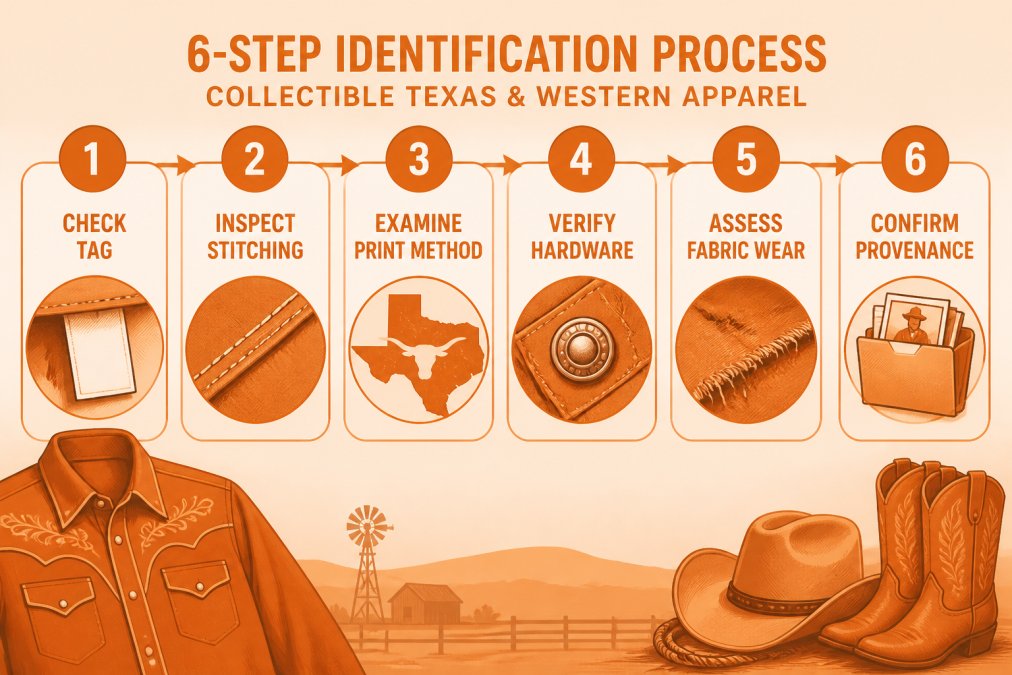
Start with the label. Union-made tags, defunct brand names, and manufacturer markings that changed style over decades are the fastest dating tool available.
(/blogs/txmrb-com-blogs-txmrb-blog/why-buy-independent-artist-music) is apparel and goods produced by the artist or a small studio rather than a licensed manufacturer. Smaller runs are exactly what create long-term collectibility.Collectors chase scarcity, and small-batch runs are scarce by design.
How to support independent artists without guessing:
- Buy directly from the artist's own store when one exists
- Ask how the item was made and in what quantity
- Keep the packaging, insert cards, and any signed materials
This is where our own work fits. Every TXMRB piece is designed and made in small batches in Liberty Hill, and the apparel line runs from the TXMRB Performance Tee at $19.85 to the TXMRB heavyweight fleece hoodie at $41.50, plus the wool blend structured cap at $20.68.


If you're coming from mass-market Western wear, expect the difference to show up in construction details rather than labels. That's the point.
A Collector's Buying Checklist
The category rewards patience. Buy fewer pieces, document them properly, and store them well, and the collection holds together far better than a rack of impulse finds.
Frequently Asked Questions
What makes Texas style apparel collectible?
Three things usually decide it: scarcity, story, and condition. A shirt tied to a specific maker, event, or regional design is harder to replace than a mass-produced piece, and that scarcity drives interest. Condition matters just as much, since fading, cracked prints, and missing buttons cut value fast. Provenance, meaning documented origin or a known maker, adds the most weight. Collectors tend to prioritize pieces they can trace and preserve rather than whatever is trending that season.
How can you tell whether a Texas-style shirt is vintage or newly made?
Start with the tag. Older shirts often carry union-made labels, older fiber content wording, or a single-stitch hem, while newer production usually shows double stitching and modern care symbols. Print method is another clue: vintage graphics tend to sit in the fabric with slight cracking, while new prints often feel like a raised layer. Hardware helps too, since older snaps and buttons show wear patterns that are hard to fake. When two or three signals agree, you have a reasonable answer.
How do you care for collectible graphic tees?
Wash them inside out in cold water on a gentle cycle, or hand wash if the print is fragile. Skip the dryer entirely, since heat is what cracks screen prints and shrinks cotton. Hang or lay flat to dry away from direct sun. Store folded rather than on a hanger to avoid shoulder stretch, and keep them out of damp spaces. For anything you plan to display, use a frame with UV-filtering glass so the graphic does not fade over time.
Is independent artist merchandise worth collecting?
It can be, especially when the run is small and the artist keeps producing. Independent releases are often made in limited quantities, which means fewer copies exist than with mass-market apparel. The value is partly financial and partly personal: you are holding something tied to a specific creator's work. Buying directly from the artist also means the money reaches the person who made the piece rather than a reseller. Start with designs you actually wear, then set aside the ones you want to keep.
Building a collection takes years, and the pieces that last are the ones with a real story behind them. TXMRB makes small-batch apparel, original Texas country music, books, and 3D-printed goods in Liberty Hill, and every item comes from an independent creative practice rather than a licensing deal. Browse the TXMRB shop to see current apparel and accessories, and start your collection with work you can trace back to the person who made it.
