

How to Use Tactile Stimulation for Better Cognitive Focus
Last Updated: October 25, 2026
Quick Summary
Tactile stimulation is physical touch input that gives your hands something to feel, press, or move, and research links it to modest gains in attention. A 2020 study found tactile training improved visual sustained attention in young adults, while a 2025 study reported auditory-tactile signals sped up target detection during multitasking. Effects are small and vary by person, so treat it as a focus aid, not a treatment.
- A 2020 study led by Y. Luo found tactile training improved visual sustained attention in young adults.
- A 2025 study led by A. G. Gaillet reported auditory-tactile signals sped up target detection in multitasking.
- A 2025 review led by L. Frau found touch calms some people but has the opposite effect for others.
- Match the fidget motion to your habit: press, spin, roll, grip and trace, or squeeze.
- Run the four-point quiet test and score 4 to 8 for a genuinely office-quiet fidget.
Table of Contents
- What the Research Says About Tactile Stimulation and Cognitive Focus
- Why Quiet Fidget Toys for Adults Fit Into Shared Workspaces
- How to Choose a Fidget Toy by Sensory Preference
- Testing Whether a Fidget Is Actually Office-Quiet
- Fidget Toys for Studying: Matching Texture to the Task
- Setting Realistic Expectations About Focus and Stress Relief
- Durability, Maintenance, and Hygiene
- Pick a Fidget That Matches How You Think
- Frequently Asked Questions
What the Research Says About Tactile Stimulation and Cognitive Focus
Tactile stimulation is physical touch input that gives your hands something to feel, press, or move, and researchers are studying how it affects attention. This guide from TXMRB looks at what the science actually shows and how to use it well at a desk. The short version: the evidence is real but narrow, and it does not promise a magic fix.
Here is the honest state of the research.
The 2020 Tactile Training Study
A 2020 study led by Y. Luo found that tactile training improved visual sustained attention in young adults. Participants showed higher accuracy and calculation efficiency, plus fewer omissions after training, according to the tactile training and sustained attention study.
Two limits matter. The sample was young adults, and the task was a lab attention exercise, not a workday.
The 2025 Multitasking Study
A 2025 study led by A. G. Gaillet reported that auditory-tactile signals sped up target detection in a multitasking condition compared with audio alone.
A separate 2025 review led by L. Frau notes that touch can regulate emotions and stress responses. It also found that touch may calm securely attached people while having the opposite effect for people who want autonomy.
That last finding is the one most fidget guides skip.
Why Quiet Fidget Toys for Adults Fit Into Shared Workspaces
Quiet fidget toys for adults work in shared spaces because they deliver sensory input without sound. For a curated list of office-friendly options that actually boost focus, see our best fidget toys for office focus.
The office case is practical, not medical:
- Long meetings reward a low-noise outlet for nervous energy
- Open floor plans punish clicking, rattling, and dropping
- A desk toy you can keep out of sight reduces self-consciousness
We build our fidgets with this setting in mind. Our 3D printed fidget roller spins smoothly and quietly, which is why it lives on desks rather than in drawers.

How to Choose a Fidget Toy by Sensory Preference
Choosing a fidget toy starts with one question: what does your hand want to do? Match the motion to your habit, then match the noise level and visibility to your room. Most people pick by looks and end up with a toy that feels wrong.
Start With the Feedback You Crave
Different motions give different feedback. Before you look at a product, notice what your hands already do when you are thinking: do you tap, roll a pen, press your thumb into your palm, or trace edges? That habit points to the feedback your nervous system is already reaching for.
- Press and click: continuous folding or pressing gives steady resistance and a small, satisfying give. Good for long meetings and deep work.
- Spin: steady rotation gives smooth, predictable motion. Good for study sessions and commutes.
- Roll: palm rolling gives broad, even contact. Good for open offices and phone calls because one hand stays free.
Match the Motion to the Moment
Motion should fit the moment, not the other way around. A spinner suits a quiet stretch where you can let it run. A roller suits a call where one hand is free.
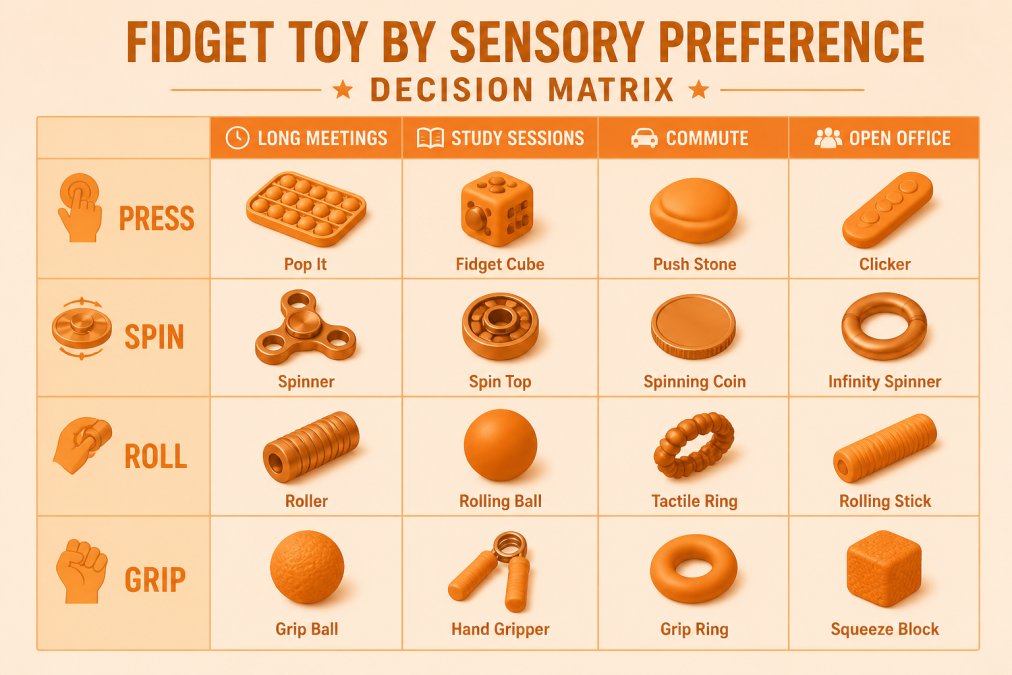
Use this decision matrix as a starting point, then adjust for your own quiet-test results:
| Sensory preference | Best motion | Good for | Visible movement? | TXMRB option |
|---|---|---|---|---|
| Press and click | Continuous folding | Long meetings, deep work | Low | Infinity Fidget Cube, $4.00 |
| Spin | Steady rotation | Study sessions, commute | Medium | Premium Fidget Spinner, $2.00 |
| Roll | Palm rolling | Open office, phone calls | Low | Fidget Flow Roller, $3.00 |
| Grip and trace | Textured spiral | Creative thinking, anxiety | Low | FidgetPoint Cone, $8.00 |
Decide How Visible You Want It to Be
Visibility is a separate choice from noise. Some people want a fidget they can use openly at a desk; others want something that disappears into a pocket. Both are valid, and the right answer depends on your workplace.
- Open use: a desk-friendly roller or cube that stays in view. Best when your team is comfortable with sensory tools.
- Discreet use: a small cube or cone that fits in a pocket and works under the desk. Best in formal meetings or shared rooms.
- Wearable use: a ring or small wearable keeps the fidget on your hand and out of sight. Best for commutes and standing meetings.
Avoid the Common Buying Mistake
Buying three fidgets at once usually means using none of them. Start with one motion you already do, test it for noise and visibility, and give it two weeks before you judge it. If it does not fit, change one variable at a time: motion first, then size, then texture.
For tactile, cube-style stimulation, the Infinity Fidget Cube folds continuously and slips into a pocket. It is $4.00 and built for daily handling.

Testing Whether a Fidget Is Actually Office-Quiet
"Silent" is a marketing word, not a measurement. The only way to know whether a fidget will bother the people around you is to test it the way your office actually sounds. This section gives you a repeatable method you can run in about ten minutes, plus a way to match the result to the situations you sit in all day.
Run the Four-Point Quiet Test
Do this in the quietest room you have access to, ideally with the door closed and the HVAC running as it normally does. Score each step from 1 (inaudible) to 5 (clearly audible across a desk).
- Shake test. Hold the fidget near your ear and shake it gently for ten seconds. Listen for loose parts, rattles, or internal clicks. Anything you can hear at arm's length will carry in a quiet room.
- Motion test. Use the fidget at your normal speed for two full minutes. Note clicks, scrapes, and rubbing sounds. Continuous folding and rolling tend to be quieter than ratcheting or clicking mechanisms.
- Desk-contact test. Set the fidget down on a hard surface, then pick it up and set it down again five times. Hard plastic on a hard desk is the loudest sound most fidgets make. Repeat on a mousepad or cloth to hear the difference.
- Neighbor test. Ask one coworker at the next desk to tell you, honestly, whether they noticed anything during a two-minute stretch. Their answer is worth more than your own ear.
Add the four scores. Once you know how to test for quietness, you can compare silent fidget toys that suit open office plans. A total of 4-8 is genuinely office-quiet. 9-14 is fine for a private office or a call where your mic is muted. 15 or higher belongs at home, not in an open floor plan.
Match the Result to the Situation
Quiet is not one standard. A fidget that is fine during focused work can be distracting on a call, and a fidget that is fine on a call can be distracting in a silent meeting room.
- Focused work at a shared desk: prioritize the desk-contact score. Rolling and folding motions that stay in your hand are the safest choice.
- Calls and video meetings: prioritize the motion score. One-handed rolling keeps your other hand free and your mic clear. Avoid anything that clicks near the microphone.
- Meetings and quiet rooms: prioritize the shake score. If it rattles when you move it, leave it in your bag.
Use It Without Making It Someone Else's Problem
Quiet testing is only half of etiquette. A few habits keep a sensory tool from becoming a distraction:
- Keep the fidget below desk level or in a pocket during meetings.
- Stop using it if a coworker asks, without requiring an explanation.
- Do not assume you owe anyone a disclosure about why you use it. Sensory tools support different needs, and you are not required to share a diagnosis or a reason.
Fidget Toys for Studying: Matching Texture to the Task
Fidget toys for studying should match texture to the type of thinking. Smooth surfaces suit reading and memorization. Textured surfaces suit problem sets and brainstorming.
Try these pairings:
- Reading and notes: smooth roller, slow motion
- Math and coding: spiral cone you can trace
- Flashcards: small cube with light resistance
Texture matters because it changes how much attention the toy demands. A bumpy surface pulls your eyes down. A smooth one lets your hands work while your eyes stay on the page.
Keep the toy out of sight during timed tests and lectures where it might draw attention.
Setting Realistic Expectations About Focus and Stress Relief
Fidget toys are a focus aid and a stress management tool, not a treatment. The research shows effects in specific lab tasks, not a guaranteed boost at your desk.
Set expectations like this:
- Expect a small, personal effect, not a transformation
- Expect variation: some people focus better, some feel nothing
- Expect the toy to help most during long, low-stimulation tasks
The 2025 touch review is a useful check here. Touch calms some people and irritates others, so test before you commit.
If stress is the bigger issue, our guide on how to manage stress with fidget toys goes deeper than focus alone.
Durability, Maintenance, and Hygiene
A fidget only helps if it survives daily use and stays clean. Check for loose parts, cracks at thin edges, and wobble after a week of handling. Wipe smooth surfaces with a dry or lightly damp cloth, and keep them out of reach of very young children.
PLA construction keeps it lightweight, durable, and smooth in the hand. Avoid leaving them in a hot car.
Pick a Fidget That Matches How You Think
The best fidget is the one that matches your hand, your room, and your task. Start with one motion, test it for noise, and give it two weeks before you judge it.
At TXMRB, Michael designs and prints every fidget by hand in Liberty Hill, Texas, as part of a creative practice that also includes original country music and books.
Get started with TXMRB and find a quiet fidget that fits how you actually work.
Frequently Asked Questions
Can tactile stimulation improve cognitive focus?
Research points to a possible link, with caveats. A 2020 study of young adults found tactile training improved visual sustained attention, with increased accuracy and fewer omissions (Luo et al., 2020). A 2025 study reported faster target detection when auditory and tactile signals were combined versus auditory signals alone (Gaillet et al., 2025). Neither study tested everyday fidget toys, so treat the results as promising rather than proven for your desk routine.
Do fidget toys help adults concentrate?
For some adults, yes. The effect depends on the person and the task. Quiet fidget toys for adults give restless fingers a low-effort outlet so attention can stay on the work. A fidget that clicks, rattles, or demands visual attention can pull focus away instead. Try a quiet option like a roller or spinner during a low-stakes task first, then judge whether your concentration holds up.
What types of fidget toys are quiet enough for work or class?
Look for motion without impact: rolling, spinning, or pressing rather than clicking or snapping. A palm roller, a smooth spinner, or a spiral cone that glides across a desk produces little sound. Test any candidate in a quiet room before bringing it to a shared workspace, and keep it below desk level so it stays out of sight.
Can fidgeting make it harder to focus?
It can. A fidget that is loud, visually busy, or needs two hands competes with the task instead of supporting it. The same applies if you spend more time choosing or adjusting the toy than working. Use the fidget as background sensory input, not as the main event. If you notice your attention drifting to the toy, switch to a simpler motion or put it away for that task.
