

What Makes 3D Printed Art Unique: A 2026 Guide
Table of Contents
- What Makes 3D Printed Art Unique
- The Benefits of 3D Printing for Artists
- 3D-Printed Sculptures: Complex Geometry You Cannot Cast
- Custom 3D-Printed Art: Personalization at Small Scale
- From Concept to Finished Work: The Artistic Process
- Is 3D-Printed Art Really Handmade? Originality and Authorship
- What 3D Printed Art Cannot Do: Limits and Environmental Impact
- Conclusion: Why the Medium Matters
- Frequently Asked Questions
Last Updated: October 7, 2026
What Makes 3D Printed Art Unique
3D printed art is artwork created by building a physical object one thin layer at a time from a digital design file, rather than carving, casting, or molding it by hand. That single difference changes what artists can make, how they make it, and who gets to own the result.
The short answer to what makes 3D printed art unique is this: the artist designs in software, and the machine grows the piece layer by layer, so shapes that would be impossible or wildly expensive to carve or cast suddenly become practical. Curves inside curves. Hollow chambers.
At TXMRB, we work in this medium every day, printing fidgets, wearable pieces, and small sculptures in Liberty Hill, Texas. We are not a factory. We are one artist with a printer, and that shapes what we make.
Below, we break down where the medium genuinely beats traditional fabrication, where it falls short, and how to tell the difference before you buy.
The Benefits of 3D Printing for Artists
The biggest benefit of 3D printing for artists is design freedom without a mold. A traditional sculptor carving stone cannot undo a wrong cut. A caster needs a mold, and a mold costs money before the first piece exists. A 3D printer needs neither. That single fact reshapes the economics and the creative rhythm of making art.
Here is what that unlocks in practice, and why each one matters:
- Iteration is cheap. Change the file, print again. Version twelve costs about the same as version one, because there is no new tooling to cut. In traditional fabrication, each design change can mean a new mold or a new jig. In printing, the file is the tooling.
- Complex geometry is free. A shape with 40 holes costs the same to print as a shape with one, because the machine does not care how intricate the path is. It only cares how much material it lays down and how long the nozzle runs.
- Scale is flexible. The same digital file can produce a palm-sized piece or a large one. Resizing is a numeric change in the software, not a rebuild of a mold.
- Personalization is built in. A name, a color, a size: all just variables in the file. There is no setup fee and no minimum order, which is the opposite of how traditional manufacturing treats one-off work.
- Assembly can disappear. Interlocking parts, hinges, and captured joints can print already assembled. A mold cannot release a captive ball inside a hollow shell. A printer builds both at once.
- The design survives the object. The file remains editable years later. A carved piece is finished when the chisel stops. A printed piece can be revised, reprinted, and reissued.
The trade-off is time. A print runs for hours, and the artist is often waiting rather than working. That is the honest cost of the freedom. It also means the artist's attention shifts earlier in the process, into modeling and orientation decisions, rather than into the physical act of shaping material.
For an independent maker, that is the whole game. A small shop can offer a custom piece without committing to a production run, and a buyer can get something made for them rather than picked off a shelf. You can see that approach in the TXMRB shop, where pieces are made to order rather than mass-produced.
3D-Printed Sculptures: Complex Geometry You Cannot Cast
3D-printed sculptures can include internal structures, interlocking parts, and undercuts that a two-part mold physically cannot release. That is the technical heart of why the medium matters.
Think about a cast object. To remove it from a mold, every surface has to pull away cleanly. Anything trapped inside a hollow space stays trapped. A printer has no such limit. It builds the inside and the outside at the same time, layer by layer.
You can see this in small things as clearly as large ones. Our Mini Articulated Dragon comes out of the printer with every joint already formed and already movable. No assembly, no pins, no glue. That is a shape a mold cannot produce.

Materials, Texture, and Surface Finish Trade-Offs
Material choice decides how a piece looks and feels, and every option involves a trade-off. PLA, the most common filament for artistic work, is a bio-based thermoplastic made from renewable plant-derived feedstocks. It prints crisp detail, holds color well, and feels light in the hand.
What most guides skip is the finish. A 3D print shows faint layer lines, the horizontal ridges left by each pass of the nozzle. Some artists sand and prime them away. Others leave them visible on purpose, because the texture is part of the piece and marks it as printed rather than molded.
Resin printing produces smoother surfaces and finer detail, but the material is heavier, more brittle, and needs washing and curing after the print. Metal printing exists too, mostly for industrial and architectural work, and it costs far more than most independent artists can justify. For small decorative objects and wearable pieces, filament is usually the right call.
Custom 3D-Printed Art: Personalization at Small Scale
Custom 3D-printed art is where the medium quietly beats almost everything else. Because the object comes from a digital file, making one unique version costs almost nothing extra. No setup fee. No minimum order. No mold to cut.
That is a real shift. In traditional manufacturing, personalization is expensive because the tooling is expensive. In 3D printing, the tooling is the file.
Our Modular Snap Bracelet is a good example. Each bracelet is built from individual links that snap together without tools, so you choose the colors, add or remove links for fit, and rebuild it whenever you want a different look. The customization is not a service we perform on top of the product. It is the product.
The same logic applies across the medium. A name embossed into a coaster. A figurine scaled to match a shelf. A color matched to a team. Each one is a small edit to a file, not a new production run.
From Concept to Finished Work: The Artistic Process
The artistic process behind 3D-printed art runs through six stages, and each one changes the piece in a way you can see in the final object.
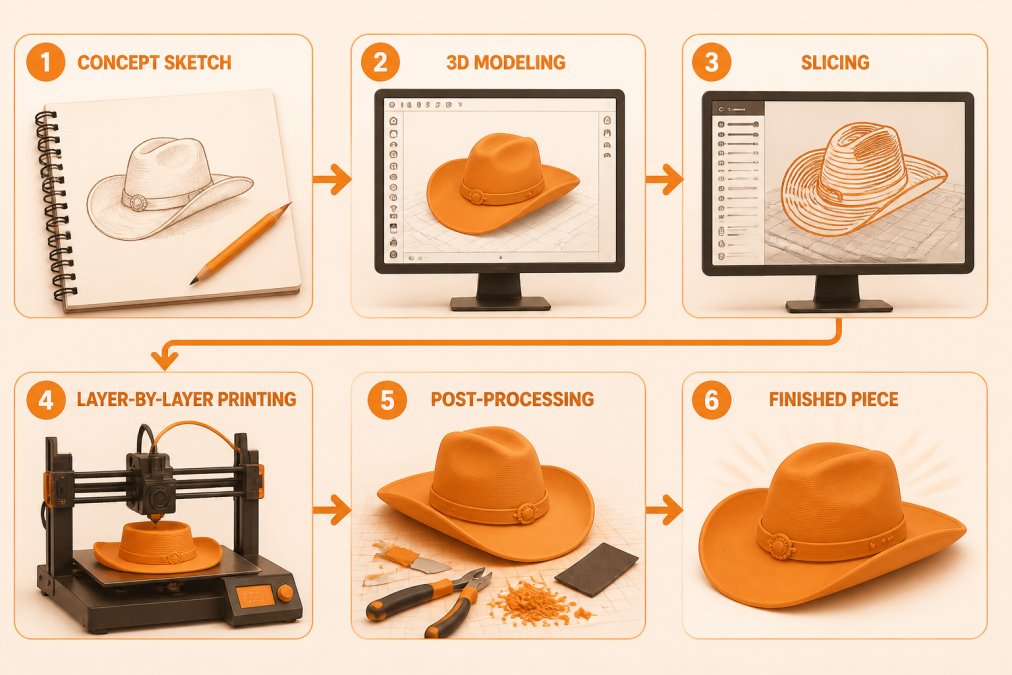
- Concept. A sketch, a rough shape, an idea worth testing.
- 3D modeling. The idea becomes a digital design file with real dimensions.
- Slicing. Software cuts the model into the thin layers the printer will follow.
- Printing. The machine builds the object layer by layer, often over several hours.
- Post-processing. Support material comes off, edges get cleaned, surfaces get finished.
- Finishing. Assembly if needed, then inspection before the piece is done.
Steps one, two, and five are where the artist's hand actually lives. The printer handles step four. That distinction matters more than people expect, and it leads straight into the next question.
Is 3D-Printed Art Really Handmade? Originality and Authorship
Yes, 3D-printed art can be genuinely handmade, provided the artist designed the file. The authorship sits in the design, not in the motion of a chisel.
Here is the honest version. If an artist downloads someone else's file and presses print, that is reproduction, not authorship. If the artist models the piece, decides the proportions, chooses the material, sets the print orientation, and finishes the surface, that is original work made with a new kind of tool.
The same question followed photography, screen printing, and digital illustration. The tool changed. The authorship question stayed the same: who made the creative decisions?
There is a practical side too. Copyright protects the design file and the original artwork, and licensing terms vary by source. Artists who sell printed work need to know where their files came from and what those files permit. Buyers who care about originality should ask the same question.
What 3D Printed Art Cannot Do: Limits and Environmental Impact
3D-printed art has real limits, and pretending otherwise does not help anyone. Most guides skip this section entirely, which is exactly why it is worth slowing down on.
Size is capped by the machine. A print bed sets the maximum footprint of a single piece.
Layer lines are visible unless the artist spends serious time finishing. The horizontal ridges left by each pass of the nozzle are the signature of filament printing.
Material behavior varies more than buyers expect. Some filaments are brittle under impact. Some warp on a hot day. Resin prints hold finer detail but can crack if dropped.
Failed prints are part of the process. A print can fail hours in, from a clog, a warp, a power interruption, or a support that did not hold. The material and time are lost.
Environmental impact deserves an honest look. PLA is bio-based, made from renewable plant-derived feedstocks, but it is not a free pass.
None of this makes the medium worse than traditional methods. It makes it different, with its own set of trade-offs that a buyer or a new artist should understand before committing. Knowing the limits is what lets an artist design around them instead of fighting them.
Conclusion: Why the Medium Matters
The thing nobody tells you about 3D-printed art is that it is not a shortcut around craft. It is a different set of craft decisions: what to model, what to leave visible, what material suits the piece, and what the machine should be allowed to do.
That is the throughline here. The printer removes the mold, the minimum order, and the geometry ceiling. It does not remove the artist.
If you want to see what that looks like in practice, browse the TXMRB shop. Every piece is designed and printed by hand in Liberty Hill, Texas, made to order, and shipped in 3-5 business days. Start with a Fidget Flow roller or the FidgetBlade and see the layer lines for yourself.


Frequently Asked Questions
Can 3D-printed art be considered handmade?
It depends on how much of the process the artist controls. When a maker designs the model, chooses the material, tunes the printer, and finishes the piece by hand, the work carries real authorship. A 3D-printed bracelet or dragon still involves design decisions, color choices, and cleanup that a factory line skips. The printer is a tool, the same way a kiln or a printing press is a tool. What matters is who made the creative calls.
What materials can artists use to create 3D-printed art?
The most common material for home and small-studio printing is PLA, a bio-based thermoplastic made from renewable plant feedstocks. It prints cleanly, holds fine detail, and comes in many colors. Resin offers smoother surfaces and sharper miniature detail but needs extra handling. Metal and ceramic printing exist too, though they usually require industrial equipment. For wearable pieces like bracelets, PLA keeps the weight low and the finish comfortable.
How do artists personalize 3D-printed pieces?
Personalization starts in the digital file. An artist can resize a model, swap colors, add a name, or rebuild a design around a customer's request before anything prints. TXMRB's Modular Snap Bracelet takes this further: you pick colors, add or remove links, and rearrange the design yourself without tools. Custom 3D-printed art also covers one-off commissions, where the file changes to fit a specific wrist, desk, or shelf.
What 3D printed items sell most?
Small, tactile, and gift-friendly items tend to move fastest. Articulated figures, fidget tools, desk pieces, and wearable accessories all fit that pattern because they are easy to hold, easy to gift, and priced for an impulse buy. At TXMRB, the Mini Articulated Dragon inside its twist-open egg and the Fidget Flow roller are built for exactly that kind of everyday use. Useful objects outsell pure display pieces in most small-shop catalogs.