

7 Tips for Managing Stress at Work That Actually Help
Last Updated: October 23, 2026
Quick Summary
Managing stress at work starts with a quick self-assessment to identify your top two triggers, then using short resets like box breathing, desk-friendly movement, and fidget tools to interrupt the stress response before it snowballs. From there, set clear boundaries, plan tomorrow's top three tasks today, and build a recovery routine that fits your real week.
- Rate six stress signals from 1 to 5 over two weeks; a score of 21 to 30 means it is time to change something real.
- Box breathing means inhaling, holding, exhaling, and holding for 4 counts each, repeated four times.
- Pick three tasks each morning and treat everything else as a bonus.
- A shutdown ritual replaces the lost commute: write tomorrow's top three tasks, close work tabs, and take a short walk.
- Burnout is exhaustion that does not lift after a weekend off, so talk to a doctor if signs last for weeks.
Table of Contents
- Start With a Quick Self-Assessment
- Quick Stress Relief at Work: 5 Resets That Take Under 5 Minutes
- Time Management Tips for Work Stress That Cut the Overwhelm
- How to Set Boundaries at Work Without Burning Bridges
- Signs of Burnout at Work You Should Not Ignore
- Talk to Your Manager: Scripts for Workload and Support
- Managing Stress at Work When You Are Remote or Always On
- Build a Recovery Routine That Fits Your Real Week
- Frequently Asked Questions
Start With a Quick Self-Assessment
Most tips for managing stress at work skip the first step: figuring out what is actually stressing you out.
Work stress is the pressure you feel when job demands outpace your time, energy, or support. It shows up in your body, your mood, and your output.
Rate each item from 1 (never) to 5 (daily) over the past two weeks:
- I feel tense in my shoulders, jaw, or stomach during work hours
- I check messages outside my work hours
- I skip breaks because there is too much to do
Write down your top two triggers. That list drives everything below.
Quick Stress Relief at Work: 5 Resets That Take Under 5 Minutes
Short resets work because they interrupt the stress response before it snowballs. The CDC lists deep breathing, stretching, meditation, journaling, and time outdoors as healthy ways to cope with stress (CDC guidance on managing stress). Here are five you can do at your desk:
- Box breathing: inhale 4 counts, hold 4, exhale 4, hold 4. Repeat four times.
- Shoulder roll and neck tilt: 30 seconds each side.
- Walk to the water cooler: the point is the walk, not the water.
- Two-minute brain dump: write every open task on paper, then close the notebook.
- Hands-on reset: roll a small tactile tool between your fingers for a minute or two.
The 3-3-3 Breathing Pattern
Breathe in for 3 seconds, hold for 3, out for 3. It is easy to remember under pressure, which is why it beats complicated routines. Try three rounds before a hard call.
Desk-Friendly Movement and Fidget Tools
Movement and touch give restless energy somewhere to go. We keep a few quiet options on our desk: the Infinity Fidget Cube ($4.00) for continuous flipping, the FidgetPoint spiral cone ($8.00) for rolling and spinning, and the Fidget Flow roller ($3.00) for a smooth, silent spin. All three are 3D printed by hand in Liberty Hill, Texas, and none click or rattle.


Time Management Tips for Work Stress That Cut the Overwhelm
Overwhelm usually comes from unclear priorities, not too little time. These time management tips for work stress start with one move: decide what matters before the day decides for you.
- Pick three tasks each morning. Everything else is a bonus.
- Block your calendar for deep work and treat those blocks like meetings.
- Batch small tasks into one 30-minute window.
Plan Tomorrow in Ten Minutes Today
Before you log off, spend ten minutes writing tomorrow's top three tasks, your first action for each, and anything you are waiting on. You start the next morning with direction instead of dread. This habit does more for work-life balance than most apps.
How to Set Boundaries at Work Without Burning Bridges
Boundaries are not walls. They are agreements about when and how you are available. The hard part is saying one out loud without sounding difficult, then holding the line when someone tests it.
Prepare Before You Speak
Most boundary conversations fail because they happen mid-stress with no plan. On a calm day, write down three things:
- The specific limit. Not "I need more balance" but "I do not answer messages after 6 p.m." A boundary you cannot describe in one sentence is not ready.
- The reason, kept short. "So I can be sharp tomorrow" lands better than a long justification. You do not owe anyone a full explanation.
- The alternative you can offer. A boundary plus an option feels like problem-solving, not refusal. "I will review this first thing in the morning" is a boundary with a door in it.
Scripts You Can Adapt
Adjust these starting points to your workplace and manager.
For after-hours messages:
"I noticed messages are coming in late. I will respond first thing in the morning unless something is truly urgent.
For a meeting-heavy calendar:
"I am trying to protect focused work time.
For a request that does not fit:
"I can take this on, but something else needs to move.
Expect Pushback, and Plan for It
The first test usually comes quickly: a late message, a last-minute request, a "quick favor." Decide in advance how you will respond. Two rules help:
- Repeat the boundary once, calmly. You do not need a new reason each time.
- Offer the alternative again. Consistency plus a workable option is what makes a boundary stick.
If pushback is persistent, that is information. It may mean the boundary needs to be a team conversation rather than a personal one, which is covered in the manager section below.
Follow Through and Review
A boundary only works if it is consistent. Pick one to practice for two weeks, then check in: did you hold it, and what happened? Most people find the feared consequence, a damaged relationship or a bad review, never arrives. If it does, you have real data for a conversation instead of a vague worry.
Signs of Burnout at Work You Should Not Ignore
Burnout is not a busy week. It is exhaustion that does not lift after a weekend off. Watch for these signs of burnout at work:
- Energy: you wake up tired, and rest no longer helps
- Engagement: you feel detached, cynical, or numb about work you used to care about
- Effectiveness: simple tasks take twice as long, and focus slips
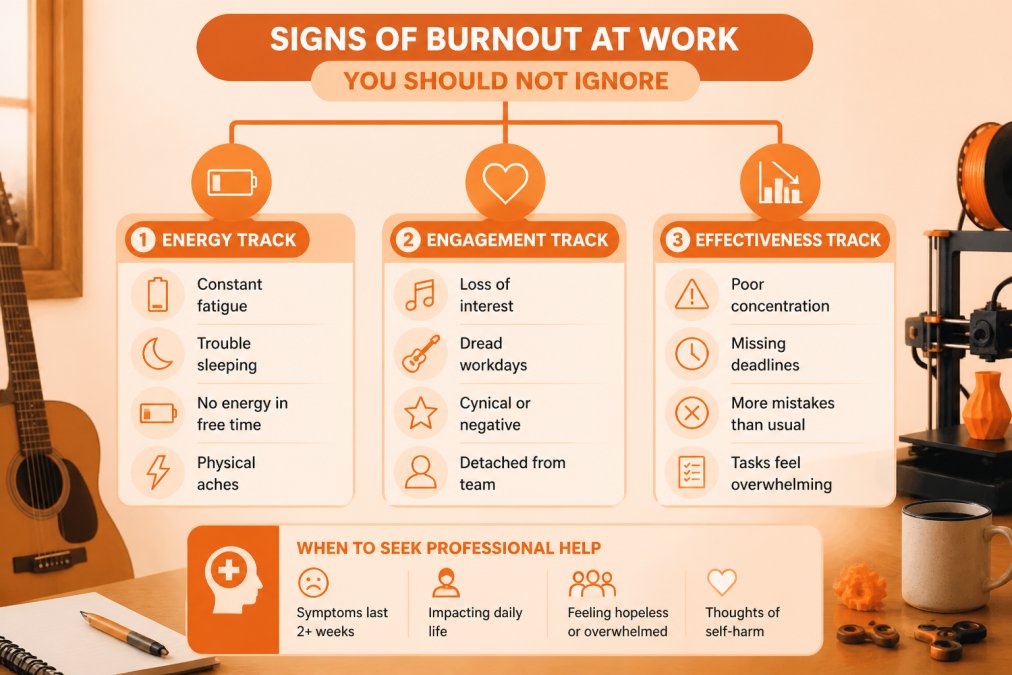
If these signs last for weeks and start affecting sleep, appetite, or relationships, talk to a doctor or a licensed mental health professional. That is not weakness. It is maintenance.
Talk to Your Manager: Scripts for Workload and Support
Managers matter more than most people realize.
Try these scripts:
For an overloaded plate:
"I want to keep delivering good work. Right now I have five priorities and capacity for three. Can we agree on which two to move or push?"
For after-hours messages:
"I noticed messages are coming in late. I will respond first thing in the morning unless something is truly urgent.
For support:
"I have been running at a high pace for a few weeks.
Keep it short, specific, and focused on the work. You are solving a problem together, not filing a complaint.
Managing Stress at Work When You Are Remote or Always On
Remote work blurs the line between office and home. Without a commute, the day never really ends, and the laptop is always one room away. Managing stress at work from a kitchen table takes deliberate structure, because the usual end-of-day cues are gone.
Name the Three Remote Stressors
Remote and hybrid stress usually comes from one of three sources. Knowing yours points to the right fix.
- Digital overload: notifications, chat pings, and a full inbox that never closes. The fix is about channels and timing, not willpower.
- Meeting fatigue: back-to-back video calls with no transition time. The fix is about calendar design.
- Blurred boundaries: work bleeding into evenings, weekends, and the space where you relax. The fix is about physical and time cues.
Build a Shutdown Ritual That Actually Ends the Day
A shutdown ritual is a short, repeatable sequence that tells your brain the workday is over, replacing the commute you no longer have:
- Write tomorrow's top three tasks and your first action for each.
- Close every work tab and app.
- Say or write one line: "The day is done."
- Do a short physical transition, like a ten-minute walk around the block.
The point is the signal, not the walk. Repeat the sequence at the same time daily and it becomes a cue rather than a chore.
Reduce Digital Overload With Channel Rules
Always-on stress is often a channel problem. Try these rules and adjust to your team:
- Set a response window and tell people what it is: "I check email at 10 and 2."
- Turn off non-urgent notifications after your end time. Keep one channel open for true emergencies and define what counts.
- Batch messages into two or three windows a day instead of reacting to every ping.
Design Your Calendar Against Meeting Fatigue
Back-to-back calls leave no time to think, and the fatigue builds quietly. Two habits help:
- Leave a five- to ten-minute buffer between calls so you can stand up, refill water, and reset.
- Protect one no-meeting block each day for focused work, and treat it like a meeting you cannot move.
If your calendar is already full, the fix is a conversation about priorities, not a new app. The manager scripts above are a good place to start.
Separate Work Space From Rest Space
If you can, use a separate workspace, even a corner of one room, and leave it at day's end. Physical separation reinforces time separation. If space is tight, covering the laptop or putting away your work tools serves the same purpose.
Watch for Isolation
Isolation amplifies stress. Remote work quietly removes the small social contact that used to break up the day. Schedule one short check-in with a colleague you like, and keep it on the calendar.
The Hybrid Schedule Trap
The same rules apply on a hybrid schedule, with one addition: home days are not automatically lighter. Plan them like office days, with a start time, a shutdown ritual, and protected focus blocks. Otherwise home days become overflow days, and stress follows you between them.
Build a Recovery Routine That Fits Your Real Week
Recovery refills the tank, and it has to fit your actual life. A routine you cannot keep is worse than none. Start with three small anchors:
- A daily walk, even 15 minutes, preferably outdoors.
- A weekly screen-free hour with something you enjoy.
- A monthly check-in using the self-assessment from the top of this page.
Research on work stress suggests that organizational changes, like better management and built-in breaks, are seen as effective alongside individual coping (study of work stress causes and interventions).
| Stressor | Fast Fix | Weekly Habit |
|---|---|---|
| Constant interruptions | Notifications off, 90-minute focus block | Batch messages twice a day |
| Overloaded plate | Three-task rule | Weekly priority check with manager |
| Always-on feeling | Shutdown ritual | One screen-free evening |
| Restless hands | Fidget tool at the desk | Short movement breaks |
| Low mood | Talk to someone you trust | Outdoor time three times a week |
Work stress rarely disappears on its own, but small, steady changes add up. Explore the Premium Fidget Spinner ($2.00) or browse the full TXMRB fidget collection, each piece 3D printed by hand in Liberty Hill, Texas, and shipped in 2-5 business days.
Frequently Asked Questions
What is the 3-3-3 rule for stress?
It is a grounding method: pause and name three things you can see, three sounds you can hear, and three parts of your body you can feel. The goal is to pull your attention out of a spiral and back to the present. It takes about a minute and works in a meeting or at your desk. The CDC lists breathing and meditation among healthy ways to cope with stress. The 3-3-3 rule is a simple version you can use between tasks.
How can I calm down quickly when I feel stressed at work?
Try a slow breathing pattern first, then move. The CDC recommends deep breathing, stretching or meditation, journaling, and time outdoors as healthy ways to cope with stress. At your desk, a two-minute stretch, a short walk to refill water, or a quiet fidget tool can channel nervous energy without disrupting anyone. Keep one reset you can do in under a minute, so you actually use it during a hard moment instead of waiting for a break.
What are the signs of burnout at work?
Watch for three patterns: running out of energy, feeling detached or cynical about your job, and noticing that you are less effective than you used to be. Other signs include dreading the workday, snapping at coworkers, and needing longer to recover after work. If those signs last for weeks and start affecting sleep or health, talk to a healthcare professional. Catching them early makes it easier to adjust workload and boundaries before things get worse.
How do I set boundaries at work without sounding difficult?
Use a short, specific script. For example: "I can take this on if we push the other deadline to Thursday. Which matters more?" That frames it as a prioritization question, not a refusal. Name your work hours and response times once, then hold them consistently.
